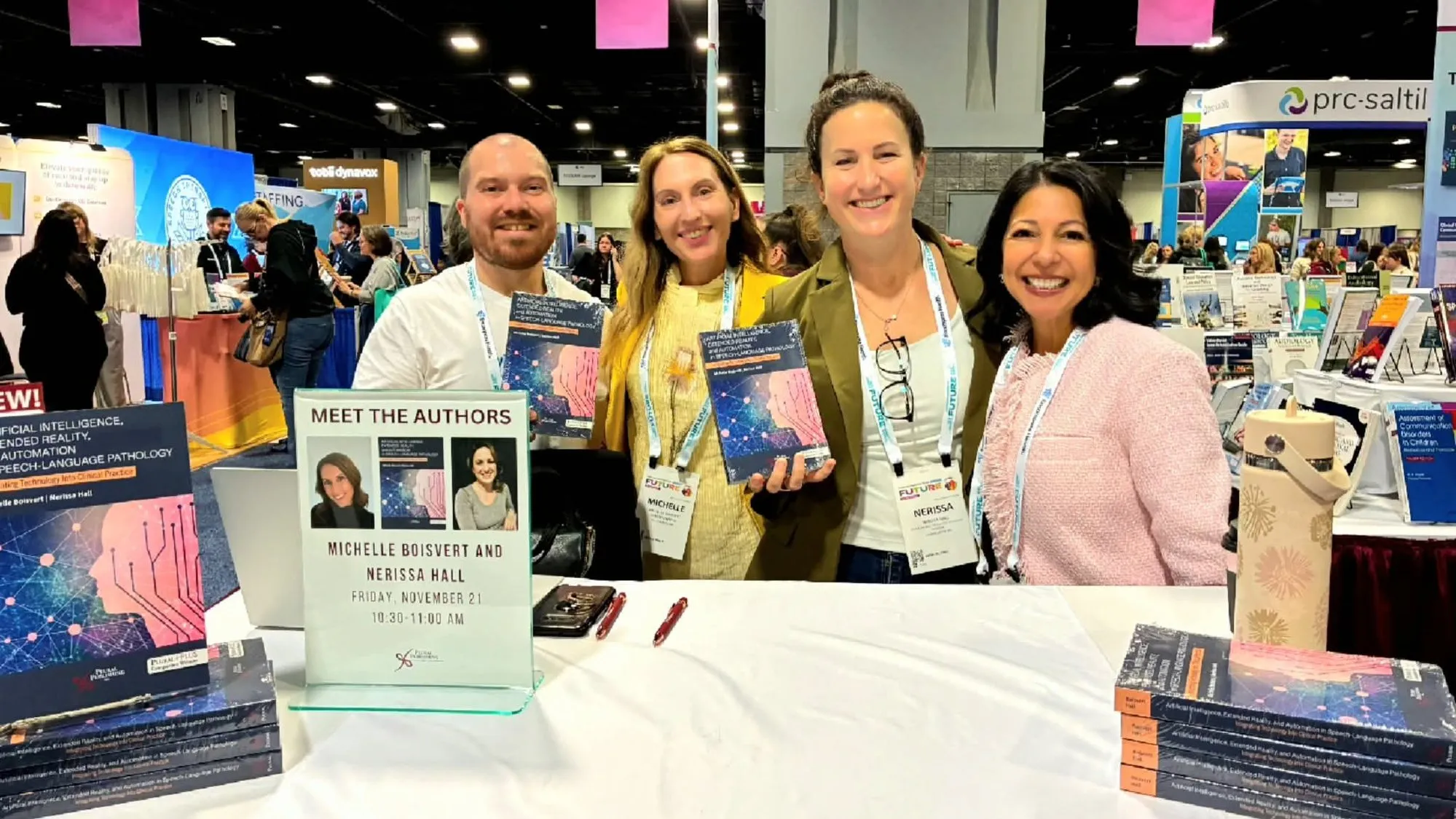
Not long ago, the iPad was the scary new thing in our field. When speech-language professionals first started carrying them into sessions around 2010, plenty of people worried it was a gimmick, a distraction, a shortcut around the real work. Go back further and you find the same uneasy conversation about telepractice, about AAC devices, even about voice recordings. Every one of those tools was, at some point, the intimidating newcomer, and every one of them became something we would now struggle to practice without. The constant through all of it was never the technology. It was the judgment: deciding which tool was credible, which was backed by evidence, which was worth the time and the trust it asked of us and the people we work with. In his foreword to this book, Martin Hall calls our moment what it is, “an environment of constant professional disruption,” change moving at something close to Moore’s-Law speed. The tools keep arriving. The hard part is still knowing which ones belong in your practice.
That judgment is exactly what Michelle Boisvert and Nerissa Hall set out to support in their new book, and they do it with rare honesty. I should say up front that they invited me to contribute, so I am not a neutral voice here. But what I want to do in this post, and in the ones that follow it, is walk you through their book as a whole: a calm, practical guide to adopting artificial intelligence, extended reality, and automation without losing the person in front of you.
A field guide for adopting new technology
The book is Artificial Intelligence, Extended Reality, and Automation in Speech-Language Pathology: Integrating Technology Into Clinical Practice, by Michelle Boisvert and Nerissa Hall, published by Plural Publishing (2025). It is a 368-page field guide, seventeen chapters across five sections, written for clinicians who want to understand the new wave of technology without losing sight of the person they are working with.
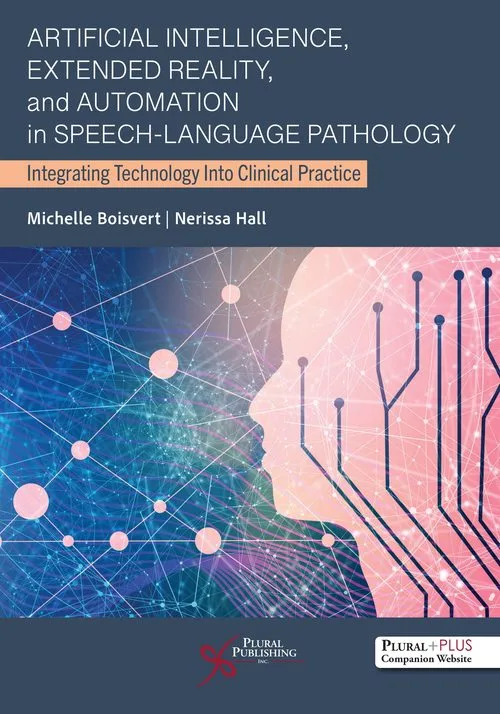
What I admire about how Michelle and Nerissa built it is the honesty. It is not a sales brochure for shiny tools. Each of the three technology sections moves from foundations to real case studies to a clear-eyed look at the future, and the whole book keeps returning to the same grounded questions: does this actually help the person, is it ethical and culturally responsive, and is it worth the cost and effort to adopt? They even give clinicians a framework for answering that, called iCARE, so that taking on a new tool is a deliberate decision rather than a trend you get swept into. The book opens by placing today’s technology in the long history of our field, spends its middle on the three families of tools in turn, and closes by showing how to thread all of it through real practice.
The three technologies it takes seriously
The heart of the book is three kinds of technology, given equal and serious attention. Here is what each one means, in plain terms, and what the book does with it.
Artificial intelligence
Artificial intelligence is the broad umbrella for software that learns patterns from data rather than following rules a person wrote out by hand; the large language models behind tools like ChatGPT are one branch of it. The foundations chapter, by Yao Du, Lori Price, and Kathryn Lubniewski, does something genuinely useful: it defines the words clinicians keep hearing without ever being told what they mean, and it reframes training a model as something we already understand, giving examples, feedback, and repetition, while naming the failure modes to watch for, like a model that confidently makes things up. The applications chapter, by Michelle and Nerissa, turns that into practice, teaching a repeatable way to write a good prompt and showing AI build a tailored therapy activity, always under the clinician’s review and never with identifiable client data. And the future chapter makes a quietly empowering case: that speech-language professionals should be active shapers of how AI enters the field rather than passive recipients of it, holding throughout to the principle that AI is there for decision support, not decision replacement. The clinician stays in charge.
Extended reality
Extended reality, or XR, is the part I know best, and it is the term most people have not had defined for them, which is no fault of theirs. XR is an umbrella for technology that adds a digital layer to what you see and hear. It covers virtual reality, a fully immersive headset world that replaces what is around you; augmented reality, digital content laid over the real world, like a label floating beside an object; and mixed reality, where the two are blended so they interact. One of the most useful ideas in the foundations chapter, by Jennine Harvey, Isaac Chang, Gabriela Fonseca Pereira, and Megan E. Cuellar, is that immersion is a spectrum rather than a switch, and that the evidence base, while still young, is real and growing across populations such as aphasia, autism, cognitive change, and brain injury (for aphasia specifically, see the systematic review by Devane et al., 2023). My own chapter sits in the middle of this section as the applied, case-study piece, and the future chapter looks honestly down the road at lighter headsets, an aging-in-place use case, and the unglamorous truth that cost and a thin reimbursement model still stand between XR and routine clinical use.
Automation
Here is something I did not expect to write as the person in this book who built the virtual reality tool. The technology that may change a clinician’s week the most is not the headset. It is the boring one. Automation is simply handing a repetitive, predictable task to software so a person does not have to do it by hand, and Michelle and Nerissa make the lovely point that this is not a frightening new invention at all but a very old human habit of building tools. The case-study chapter, by Michelle, is honest about why it matters: burnout is real and measurable in our field, with roughly 46.5% of clinicians reporting it (Khan et al., 2022) and healthcare workers spending on average around 57% of their time on repetitive tasks (Moralez, 2023). The chapter walks through four jobs worth automating, scheduling, document sharing, data collection, and report writing, with tools ranging from a shared calendar to Michelle’s own easyReportPRO, software she co-founded to help clinicians get through the report writing that eats their evenings. Its most counterintuitive idea is the one I keep thinking about: the time you save has to be deliberately protected for client care, not quietly refilled with more admin.
The ideas that hold the book together
Around those three technologies sits a frame that I think is the book’s real contribution. It opens with the groundwork, the history of technology in our field, the ethics, the cultural lenses, the practical guardrails, and it closes by showing how to put it all into practice.
The opening chapter, which I co-authored with Michelle and Nerissa, makes the case that our field has always grown up alongside its tools, so today’s hesitation about AI and XR is a familiar pattern rather than a break from it. The ethics chapter, by Ellen R. Cohn, Jack Gareis, and Karen Golding-Kushner, anchors the whole book in the long-standing principles of care and treats keeping up with technology, and its ethics, as itself a professional duty; it even gives readers a recurring feature, “Take Your Ethical Temperature,” that hands you a real dilemma and pointedly refuses to supply the answer. Lesley Edwards-Gaither’s chapter on cultural considerations argues that whether a tool gets adopted often has less to do with the technology and more to do with culture, and that the people you serve should help design the tools meant for them. And Mai Ling Chan’s practical chapter is an ethics-first operating manual, built around data security, the “black box” problem of systems whose reasoning you cannot see, and the insistence that the final decision always rests with a qualified professional.
The spine that runs through all of it is the framework Michelle and Nerissa call iCARE: Integrate your clinical and technical knowledge, identify a Critical Need, Apply the right tool, Refine how you use it, and Evaluate whether it is genuinely helping. It is built specifically for clinical work, where two frameworks borrowed from education, TPACK and SAMR, only get you part of the way. iCARE is the question the whole book keeps asking, made into a method. The closing section, with K. Todd Houston mapping technology across the full arc of care from screening to discharge, and Erik X. Raj, Emma G. Rizzuto, and Gina N. Delia on the skills the next generation of clinicians will need, brings it back to the everyday work. (Erik also runs the conference I keynoted recently, which I wrote about in Life Is A Video Game.)
There is one quiet thread I find especially worth naming: several of the tools discussed were built by practitioners for their own real challenges. Michelle built easyReportPRO. Therapy withVR is the tool I built, software a person who stutters wished existed, made with hundreds of speech-language professionals and in use since 2021 in clinics, schools, and universities internationally. It is a good sign for a field when the people doing the work are the ones building the tools.
My small part in it
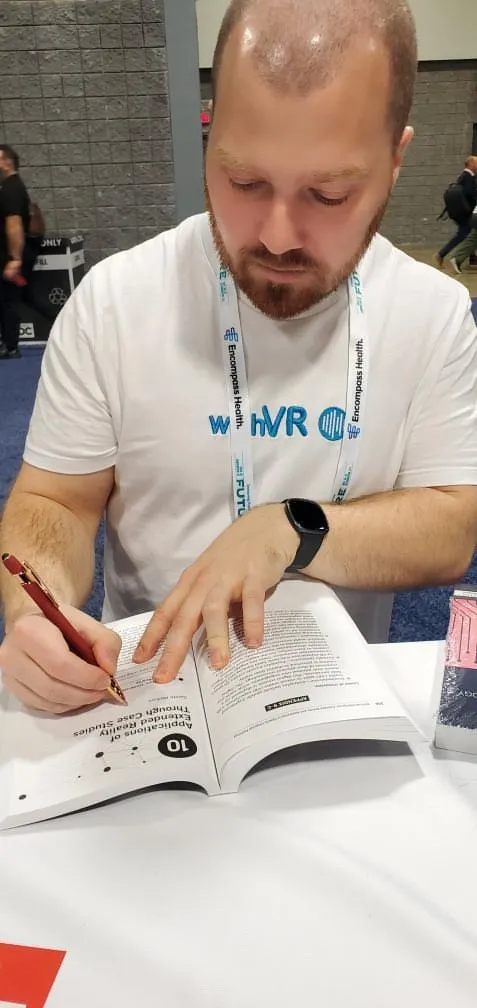
Michelle and Nerissa asked me to contribute two chapters, and I was honored that they did. I co-authored the opening chapter, Digital Generations in Speech-Language Pathology, with them, and I wrote Chapter 10, Applications of Extended Reality Through Case Studies, on my own. The short version of my chapter is that extended reality can act as a bridge from the safety of the clinic to the unpredictability of the real world, built from the environment, the people in it, the sounds, and, above all, the feeling that results, and that what makes practice carry over is not photorealism but presence, the sense of being there (Slater, 2009). I also tried to be careful about the cautions, including that AI inside XR should support the clinician and the person rather than speak for them, since today’s speech recognition still struggles with disfluent speech (Mujtaba et al., 2024). I disclose my role throughout, and if you want the longer version I have written about why a recreated situation can feel real enough to matter. But this is their book, and my two chapters are a small part of a much larger and more useful whole.
What I will write about next
This post is the overview. What I want to do from here is take the book one idea at a time and dig in, because nearly every chapter deserves a post of its own. A few I already have in mind: a plain-language short history of technology in our field, the one that reminds us every tool was once the scary new tool; a clinician’s guide to spotting whether a therapy tool is a “black box,” and the questions to ask any vendor before you trust it with client data; a walk through the iCARE framework with a real tool mapped onto it; a practical guide to writing a good AI prompt for therapy materials; and the counterintuitive automation post, the one about protecting the time you save instead of letting it fill back up with admin. If there is a chapter or an idea from the book you would most like me to start with, I would genuinely like to know.
Where to find it
The book is available now from Plural Publishing. If you are a clinician, educator, or student weighing where AI, extended reality, and automation fit in your practice, it is the most complete and honest single volume I know of, and I am grateful Michelle and Nerissa let me be a small part of it.
If you want to go deeper on the extended reality side specifically, the page for speech and language professionals explains how clinician-controlled VR practice works in a session, and why Therapy withVR exists is the personal version of the story. More about my background, including my research affiliation and my own lived experience, is on the about page.
Common questions
What is the book, and who wrote it? It is Artificial Intelligence, Extended Reality, and Automation in Speech-Language Pathology: Integrating Technology Into Clinical Practice, by Michelle Boisvert and Nerissa Hall, published by Plural Publishing (2025). Across five sections and seventeen chapters it covers three families of technology, artificial intelligence, extended reality, and automation, and how speech-language professionals can adopt them in practice with evidence and ethics kept in view.
What did you contribute to it? Michelle and Nerissa invited me to co-author the opening chapter, “Digital Generations in Speech-Language Pathology,” and to write Chapter 10, “Applications of Extended Reality Through Case Studies.” It is their book; I was honored to be asked. I disclose in the book that I am the founder of Therapy withVR.
What does “extended reality” (XR) actually mean? Extended reality is an umbrella term for technology that adds a digital layer to what we see and hear. It includes virtual reality (a fully immersive headset world), augmented reality (digital content laid over the real world), and mixed reality (the two blended so they interact). Immersion is a spectrum, not an on-or-off switch.
Who is the book for? Clinicians, educators, and students who want to understand AI, extended reality, and automation without losing sight of the person in front of them. Some chapters are technical and others are conceptual, but each one moves from plain-language foundations to real case studies, so you do not need a technical background to get value from it.
References
- Boisvert, M., & Hall, N. (2025). Artificial intelligence, extended reality, and automation in speech-language pathology: Integrating technology into clinical practice. Plural Publishing. Publisher page
- Walkom, G. (2025). Applications of extended reality through case studies. In M. Boisvert & N. Hall, Artificial intelligence, extended reality, and automation in speech-language pathology: Integrating technology into clinical practice. Plural Publishing.
- Boisvert, M., Hall, N., & Walkom, G. (2025). Digital generations in speech-language pathology. In M. Boisvert & N. Hall, Artificial intelligence, extended reality, and automation in speech-language pathology: Integrating technology into clinical practice. Plural Publishing.
- Khan, M. A., Saeed, B., Ahmed, M., Yousaf, R., Yaqoob, S., Khan, M. S. G., & Faridi, T. A. (2022). Burnout among speech language pathologists in work settings. Pakistan BioMedical Journal, 119-123.
- Moralez, M. (2023, October 12). Automation can prevent burnout within healthcare facilities. Healthcare Facilities Today.
- Slater, M. (2009). Place illusion and plausibility can lead to realistic behaviour in immersive virtual environments. Philosophical Transactions: Biological Sciences, 364(1535), 3549-3557.
- Devane, N., Behn, N., Marshall, J., Ramachandran, A., Wilson, S., & Hilari, K. (2023). The use of virtual reality in the rehabilitation of aphasia: A systematic review. Disability and Rehabilitation, 45(23), 3803-3822.
- Mujtaba, D., Mahapatra, N. R., Arney, M., Yaruss, J. S., Herring, C., & Bin, J. (2024). Inclusive automatic speech recognition for disfluent speech. Interspeech 2024.