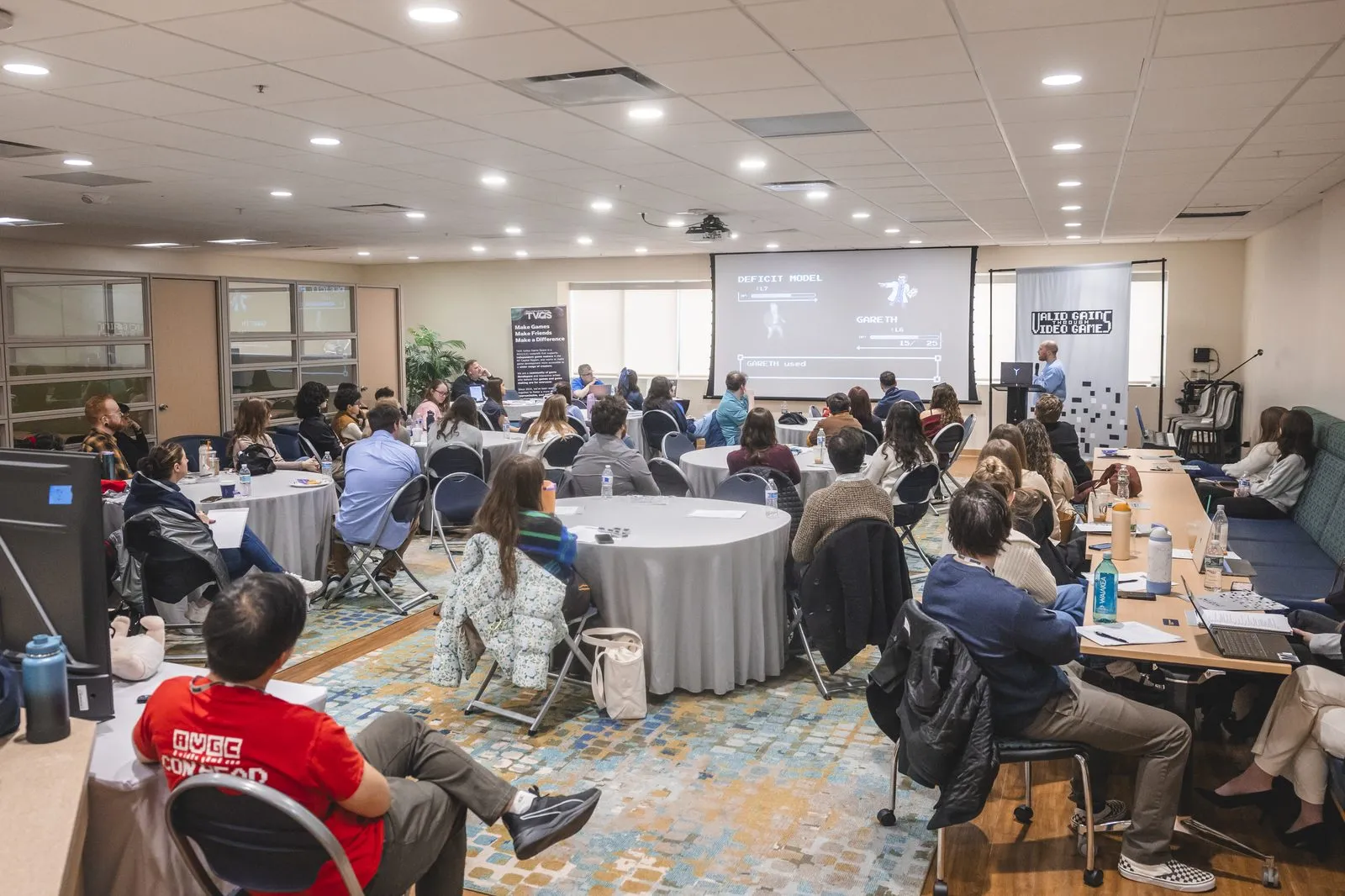
A few years ago, if you had shown me a level select screen with “keynote speaker” on it, that level would have had a padlock on it. I could not have chosen it. This year I gave the opening keynote at a conference holding a game controller, talking to a room full of people. I am a person who stutters. Standing there was not something I willed into being. It was something a lot of better-designed levels made possible.
That is the whole idea I want to share. I have spent my life playing video games, and somewhere along the way they taught me the single most useful thing I know about communication: the barriers a person who stutters runs into are almost never in the person. They are in the level design.
Don’t fix the player. Redesign the level.
This is the social model of communication told through the only language I have ever been truly at home in. I built a keynote around it, titled “Life Is A Video Game: What I’ve Learned From Navigating The Levels as a Person Who Stutters,” for VGTVG 2026, the Valid Gains Through Video Games conference founded by Erik X. Raj, who runs the MDXR Lab at Monmouth University. I structured it as eleven “levels” of my life, each one a game that taught me something about taking part. Here is the essay version, written for the people who could not be in the room, and especially for the clinicians among them.
What good levels gave me
My first level was my dad’s PC. After school I would go upstairs, turn it on, and play. No one was waiting. No timer. No leaderboard. In gaming you would call that a hub world, the safe home base a game gives you to return to between missions, with no enemies and no clock. For me it was simply a place to be without anyone waiting for me to speak.
That is lesson one, and it is not a soft one: a safe space is not a luxury, it is the foundation. Without somewhere to practice unwatched and explore unjudged, I could not move forward. Every learner needs a hub world before they are asked to enter multiplayer.
The next levels added structure. When I linked my handheld console to a friend’s with a cable to trade and battle, the game itself created the turn-taking: you go, I go, you go, I go. I did not have to work out how to interact. The game did it for me, and I was not performing, I was just there. When friends came over, a controller went around the living room, and what mattered was not the hardware but the presence, the same couch, the same laughter. And when I played a game with a rewind mechanic, where you could reverse time and try the jump again after you fell, I learned that you can fail and try again without being punished for it.
Translate those out of gaming and they are a description of an accessible environment. Turn-taking lowers the pressure. Shared goals create belonging, and belonging reduces how much communication a moment demands of you. Presence creates safety. And the permission to iterate, to try, fail, and try again, is what builds participation in the first place.
That is also the first boss. In gaming a boss battle is the big barrier at the end of a level, harder than everything before it. Mine was Perfection, the belief that you have to get it right the first time. You do not beat Perfection with more willpower. You beat it with iteration, with the rewind button, with progress over getting it perfect.
Seeing the system
The first time I used voice chat in a game, I stuttered, and I covered it by saying “it’s just lag.” Connection issues. Not me. I hid to belong. But here is the thing I only saw later: I still belonged. And then I found my actual role on the team, which was never about how much I talked. It was the grenades, the support, the strategy, watching everyone’s back. My value was in what I brought, not in my word count.
Participation is not performance. If you only measure how much or how smoothly someone speaks, you miss the whole person. If you measure whether they are part of it and what they contribute, the picture changes completely.
Two more bosses live in this stretch. One is the culture that says never stop, always be on, always push through. You beat that one by learning that stepping back is not failure. Sometimes the barrier is in the environment and not in you, and walking away is strategy, not defeat. Autonomy, choosing when and how to engage, is itself a form of access.
The bigger boss is the Deficit Model, the idea that the problem lives inside the person and the person is what needs fixing. I beat that one playing the kinds of strategy and simulation games that teach you to see in systems, to notice that an outcome is produced by rules and environments and not by a single broken part. The barriers I faced were not in me. They were in the environments around me. I am a designer, not a broken player.
And one quieter level mattered more than it looked. Racing games taught me to look many cars ahead and to handle a slide instead of fighting it. Then one winter the real car started to slide on snow, and I did not panic. I turned into it, looked ahead, and came out fine. Nobody had taught me that in a driving lesson. Play had. Skills you build in one place can show up where you actually need them, which is the same question I now spend my working life on: whether practice carries over into real life.
The levels that finally made room
When I found the international stuttering community, sometimes called Stamily, and started playing games with them, something shifted. I did not have to explain myself or justify how I talk. When you share an identity with the people around you, accessibility is automatic. Community is not just emotional support. It is infrastructure.
Then came virtual reality, and this is the part that still gets me. In VR you are not only playing a game, you are present with real people, in real time, even when they are on the other side of the world. I have played mini golf in VR with friends in Australia, including someone who also stutters, and tactical games where the voice chat felt nothing like it had years earlier. Not because I had become a different person. Because the levels got better.
The final boss is Shame, and it took the whole game to beat. Not with self-acceptance summoned out of nowhere, but with years of accumulated experience inside environments that were finally designed well enough to make room. I used to hide my stutter to stay in the game. Now I stay in the game even when I stutter. That is not because I changed. It is because the levels got better.
Which brings me back to the room, and the padlock. “Keynote speaker” used to be a locked level. I did not force it open. I reached it the way you reach any locked level: the experience accumulates, level by level, safe spaces and connection and community and better environments, even when you cannot see the bar filling. The level that looks impossible today is often just one you have not reached yet.
If you design communication environments for a living
That last sentence is really addressed to clinicians, because that is what therapy is. You are a level designer. You decide how much pressure a moment carries, how much structure and turn-taking it offers, how much control sits with the person, whether the situation is safe enough to fail in and try again.
I want to be honest about two things, because the gaming frame can make this sound tidier than it is. None of it was effortless, and good environment design does not erase every hard moment. Stuttering can be hard, and I am not here to tell anyone how to feel about their own speech or what to want from their own therapy. What I am saying is narrower and, I think, more useful: when participation stalls, the most leveraged place to look first is the level, not the player.
That belief is the reason I build VR speaking situations for a living. It is the most direct way I have found to hand a clinician a level editor. Therapy withVR lets you rebuild a real situation, a cafe, a classroom, a meeting, and redesign it in real time around the person in front of you, so they can practice it on their own terms before they meet it for real. The tool is just the level editor. The idea is older than the tool, and it is why any of this exists.
The whole talk was built as an animated, controller-driven deck, achievements popping up, boss battles rendered like the games that taught me all of this, and a static page can only carry part of it. If you want to bring the full thing to your event, the speaking page has the details, and you can read more about where this comes from.
Common questions
What was the Life Is a Video Game keynote about? It was my opening keynote at VGTVG 2026, the Valid Gains Through Video Games conference. It tells the social model of disability through eleven gaming levels of my life as a person who stutters, building to one idea: don’t fix the player, redesign the level. Barriers to communication and participation live in environments, not in people.
What does don’t fix the player, redesign the level mean? It is the social model of disability in gaming language. When a person struggles to take part, the instinct is to change the person. The social model says the barrier is in the environment, so the work is to redesign the environment, the level, rather than to fix the player.
Is this an overcoming-stuttering story? No, and that distinction is the whole point. The talk is explicit that the levels got better, not me. It is about environment design and access, not personal triumph, willpower, or speaking any particular way.
What is the social model of disability? It locates disability in a mismatch between a person and an environment that was not built for them, rather than as a flaw inside the person. The goal shifts from changing the person to removing the barriers around them. There is a fuller explanation on the social model of communication page.
Where can I see the keynote? The talk was built as an animated, controller-driven slide deck, and the animated version is the closest thing to being in the room. You can also invite me to give it; details are on the speaking page.
The game isn’t over
The talk ends on a simple screen: “Autosave in progress.” Then “Saved.” Level 12 is still locked. The game is not over, for me or for the people you work with. The next level always looks impossible right up until it does not, and the way you reach it is rarely by forcing the player to be different. It is by building a better level.