For a young person who stammers, ordering a coffee at a cafe or reading aloud in a classroom can feel like standing at the edge of a cliff. The situation itself is ordinary. The anxiety it produces is anything but. Now, NHS Trusts across England are turning to virtual reality to help children and teenagers face these moments on their own terms, using Therapy withVR, a clinician-controlled VR tool built specifically for speech and language therapy.
A new kind of practice space
Therapy withVR sits in a unique position in clinical practice: somewhere between traditional role-play and real-world exposure. The young person puts on a VR headset and steps into one of more than 12 realistic environments (a bustling cafe, a school classroom, a meeting room, a shop counter, and more). Meanwhile, their speech and language therapist controls everything in real time from a laptop.
The clinician can adjust the difficulty of the scenario, type exactly what the virtual avatars say, change the avatars’ emotional expressions, and trigger ambient sounds across the available sound categories. This level of control means the therapist can tailor each session precisely to the individual’s goals and comfort level, raising the challenge gradually as confidence grows.
For young people who stammer, this matters enormously. The situations that cause the most challenge are often highly specific: answering a question in front of classmates, giving their name at a reception desk, ordering food at a busy counter. VR lets them practice these exact scenarios with their therapist guiding the experience, adjusting the pressure in the moment, and debriefing afterwards.
Why VR works where role-play falls short
Role-play has long been a staple of stammering therapy, and it remains valuable. But it has limits. A young person knows their therapist is not really a barista. They know the classroom is actually a clinic room. This gap between role-play and real life is exactly what VR closes. The sense of presence, the feeling of genuinely being in a cafe surrounded by ambient sounds and other people, creates a more authentic emotional response without the real-world consequences of a challenging moment.
This is not about tricking the brain. It is about giving it something realistic enough to practice with. The therapist remains present throughout, offering support, adjusting the scenario, and helping the young person prepare for the situations that matter to them in daily life.
Barnsley speech and language therapy services
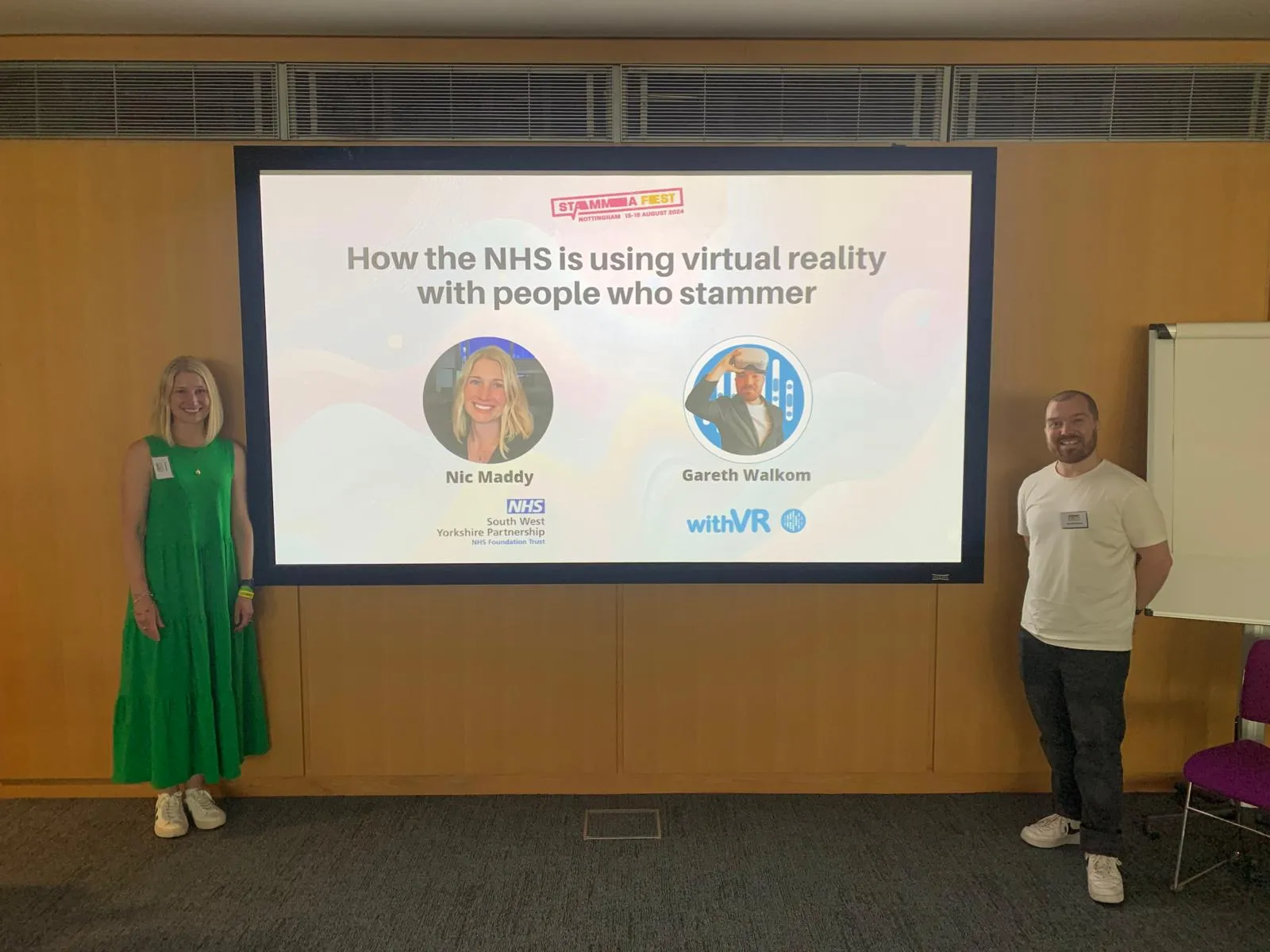
The Barnsley children’s and adult’s speech and language therapy team, part of South West Yorkshire Partnership Teaching NHS Foundation Trust, has been a pioneer in integrating Therapy withVR into NHS practice. The team, led by Nicola Maddy, has used VR to support young people who stammer across school and community settings. Their work has been covered by South West Yorkshire Partnership Teaching NHS Foundation Trust, and the local NHS charity EyUp! donated over £900 toward getting the team started with Therapy withVR.
Recognition from the NHS
The work being done with Therapy withVR in the NHS has not gone unnoticed. The project received an NHS Digital Innovation Excellence Award under the title “Using VR to empower children and young people who stammer.” The recognition was celebrated at the Trust’s Day of Staff Recognition and is featured in the Trust’s Excellence 2025 booklet. The recognition highlights both the clinical promise of the approach and the thoughtful way it has been integrated into existing NHS services.
For NHS teams evaluating new digital tools, data governance is always a central concern. Therapy withVR was designed with this in mind. No audio or video is recorded during sessions. The platform is fully GDPR compliant, and all data is hosted within the EU. These features have been important in meeting the strict information governance requirements that NHS Trusts must satisfy before adopting any new technology.
Built by someone who understands
Therapy withVR was founded by Gareth Walkom, who himself is a person who stammers. The company, withVR BV, is based in Belgium and has received support from Google, Orange, and the NHS. That lived experience is woven into the product’s design: the environments, the interactions, and the level of clinician control all reflect an understanding of what stammering therapy actually needs to achieve.
The tool is not intended to replace the therapist. It is intended to give them a new kind of instrument, one that makes practice more immersive, more targeted, and more engaging, particularly for children and teenagers who may find traditional therapy approaches difficult to connect with.
What this means for speech and language professionals
For SLPs and SLTs working with young people who stammer, Therapy withVR represents a practical addition to the clinical toolkit. It does not require a background in technology to use. The clinician dashboard is designed to be intuitive, and because the therapist controls the experience in real time, sessions can be as structured or as flexible as the individual needs.
The fact that NHS Trusts have adopted the tool, and that it has been recognized with a national innovation award, suggests that VR-assisted therapy is moving beyond the experimental stage. For young people who have spent years dreading the school presentation or the cafe counter, that shift cannot come soon enough.
Further reading
- IEP and EHCP Goal-Writing Template - For writing access-and-participation goals that pair well with VR sessions in school settings
- VR for Gender-Affirming Voice Training: What the First RCT Found - The first RCT using Therapy withVR, in a related communication area
- Writing IEP and EHCP Goals Around Access and Participation - The longer companion guide on goal-writing
- What 20 years of VR social-anxiety research means for speech therapy - The adjacent evidence base supporting this work
- Why VR speaking situations feel like the real thing - The evidence behind why VR sessions transfer
If you work with young people who stammer and want to explore how VR could fit into your practice, get in touch. I am happy to show you the software and talk through how it might work for your setting.