If you treat social anxiety, you already know where much of the change happens. Cognitive behavioral therapy is the first-line psychological treatment, and graded, repeated contact with the situations a person fears, the exposure work at its core, is one of its most powerful and best-evidenced ingredients. The cognitive models built specifically for social anxiety, like Clark and Wells, do real work alongside it, but few clinicians doubt that facing the feared situation, in a planned and repeated way, is where a great deal of the progress is made. The problem was never deciding to use exposure. The problem is running it.
I founded withVR, so I am not a neutral party here, and I will be open about where a tool fits at the end. But most of this post is about the clinical reality of delivering exposure for social anxiety, because that reality is where good intentions usually stall, and it is worth describing honestly before any product enters the picture.
How exposure therapy for social anxiety works
Within a cognitive behavioral frame, exposure for social anxiety is built on a simple, demanding idea: the way out of a feared situation is through it, at a pace the person can sustain. You and the client build an exposure hierarchy, a ranked list of feared social situations from the least to the most distressing, often rated with SUDS, Subjective Units of Distress, so you have a shared number to grade against. Then you climb it.
Each step is the same shape. The person enters a situation that carries some manageable charge, stays in it long enough for something to change, and tests what they expected to happen against what actually does. Then they do it again, because a single brave attempt rarely shifts anything, and repetition is where the change is consolidated. Along the way you are watching for avoidance and safety behaviors, the quiet maneuvers that let a person be technically present while protecting themselves from the part that matters, and gently removing them so the exposure is real.
None of this is mysterious. It is the speaking and social anxiety evidence base in one paragraph. The difficulty is almost never understanding the model. It is getting graded, repeatable, real-enough exposure to actually happen, session after session.
Why running exposure is the hard part
Here is the gap between the protocol and the week. The protocol asks for a feared social situation, gradeable and repeatable on demand. The week rarely supplies one.
Real situations are hard to arrange. As a 2019 perspective article on VR in psychiatry put it plainly (Boeldt and colleagues, 2019), in-vivo exposure is often difficult or impossible to arrange inside the office, and usually impractical to do outside it. You cannot conjure a job interview, a busy cafe counter, a lecture hall of indifferent faces, or a date on a Tuesday afternoon in your consulting room. The most feared situations are frequently the least available.
Grading and repeating on demand is harder still. Even when you can reach a real situation, you get it once, at full intensity, with no dial. You cannot ask the real audience to be a little smaller, the real interviewer to be a little warmer, or the real moment to happen again, slightly easier, three more times. A hierarchy needs fine control over difficulty. The real world offers almost none.
Exposure assigned as homework is often skipped. So much of exposure lives between sessions, and between-session exposure is exactly what clients avoid, because avoidance is the disorder. A plan that depends on someone walking into the feared thing alone, all week, is a plan that frequently does not run.
This is not a fringe complaint. In one survey of cognitive behavioral therapists in the Netherlands (Sars and van Minnen, 2015), more than half (55.3%) were not satisfied with the exposure resources available to them, citing a lack of proper protocols, and about a fifth (22.2%) reported insufficient materials to support exposure practice. The same survey found that therapists reported close to a quarter of their clients as unwilling to undergo exposure at all, with some clinicians quietly steering particularly anxious people toward other approaches instead. Read that twice: one of the most effective approaches is sometimes set aside not because it fails, but because it is too hard to deliver and too hard for an anxious person to walk into cold.
Telehealth raises the bar again. A growing share of this work now happens over video, where arranging any controlled in-vivo exposure is harder, not easier. The feared situation is on the other side of a screen, and so is the clinician.
Put together, the constraint is clear. Exposure is the treatment. A controllable, repeatable, real-enough situation is the bottleneck.
Where VR exposure therapy fits
This is the gap virtual reality was built to fill, and it is worth being precise about what the evidence does and does not support.
The headline finding, across multiple meta-analyses, is that VR exposure therapy (VRET) is about as effective as in-vivo exposure for social anxiety, with large gains against no-treatment controls. The most rigorous social-anxiety-specific synthesis to date, a pre-registered meta-analysis of 22 studies published in Psychological Medicine, found a large pooled reduction in social anxiety after VR-based exposure (Hedges g of about 0.86, with gains still present at twelve months) and early-dropout rates no different from in-person exposure (Horigome 2020). The broadest backbone, a meta-analysis of 30 randomized controlled trials across anxiety disorders, found a large effect for VRET over a waiting list (Hedges g of 0.90) and a medium-to-large effect against psychological-placebo conditions, with no significant difference from in-vivo exposure (Carl 2019). A social-anxiety-specific meta-analysis echoed that pattern: a large benefit over a waiting list (Hedges g of 0.88) and no statistically significant difference from in-person exposure at the end of treatment (Morina and colleagues, Psychological Medicine, 2021). And placed alongside other technology-assisted options, VRET produced a large effect for social anxiety, comparable to internet-delivered CBT (Kampmann 2016).
What VR actually changes for the clinician is control. It lets you manage the timing and intensity of an exposure and adjust it to the person in front of you, turning the difficulty up or down as their progress warrants. It makes exposure gradual, repeatable, and individualized, which are precisely the three things the real world refuses to be. You can summon the feared situation on demand, run it at a SUDS level you choose, dial it back when it is too much, and repeat it as many times as the session allows.
I want to be equally honest about the other side, because it matters for trust. Despite this evidence, clinician adoption of VRET remains low (Wray and colleagues, 2023). The reasons are practical and fair: the cost of hardware, the cost of licensing software, the training involved, hesitation about new technology, and reasonable skepticism about whether a simulated situation is real enough to do the work. The evidence is encouraging, not closed. Comparability with in-vivo exposure is the fair expectation rather than superiority, and even that is strongest at short-term follow-up and rests on a limited number of head-to-head trials. One dose-matched meta-analysis found in-person exposure actually outperformed VR in the social-phobia subgroup specifically (Wechsler 2019). Anyone telling you VR is a breakthrough cure for social anxiety is selling you something. What the evidence supports is narrower and more useful: VR is a credible, controllable way to deliver the exposure you were already going to do.
There is also a sign it travels beyond the research lab. In one routine private-clinic study, four clinicians with only minimal VR training ran a single roughly three-hour VR-assisted exposure session for public-speaking anxiety and saw a large drop in people’s self-rated anxiety (Lindner and colleagues, 2020). One study is not a guarantee, but it is a useful signal that this can belong in ordinary practice, not only in tightly controlled trials.
What a headset does not change
It is worth stating plainly, because the technology can make this sound tidier than it is.
The tool does not do the therapy. You do. The hierarchy, the pacing, the handling of safety behaviors, the judgment about when to push and when to hold, the relationship that makes any of it tolerable, all of that is the clinician’s work, and a headset changes none of it. It is worth being precise here: some VR products for anxiety are regulated as medical devices and make formal treatment claims, but Therapy withVR is not one of them. It is a practice tool that makes no claim to diagnose, treat, or cure, and what separates the two is intended use and the claims made, not the technology. It is a controllable place to run graded exposure practice, and it is only as good as the clinical thinking around it.
It is also not for everyone or every moment. Some people will prefer to start in the room with you and a role-play. Readiness, consent, and choice still matter, and a person who is unwilling to begin exposure does not become willing because the situation is virtual, though a gradeable, private, repeatable version of the feared thing can lower the first step enough to make starting possible. And a simulated cafe is still a stepping stone toward the real cafe. The point of any practice is the real situation it points at, which is the whole problem of carryover, and it deserves to be designed for, not assumed.
A controllable place to run graded exposure
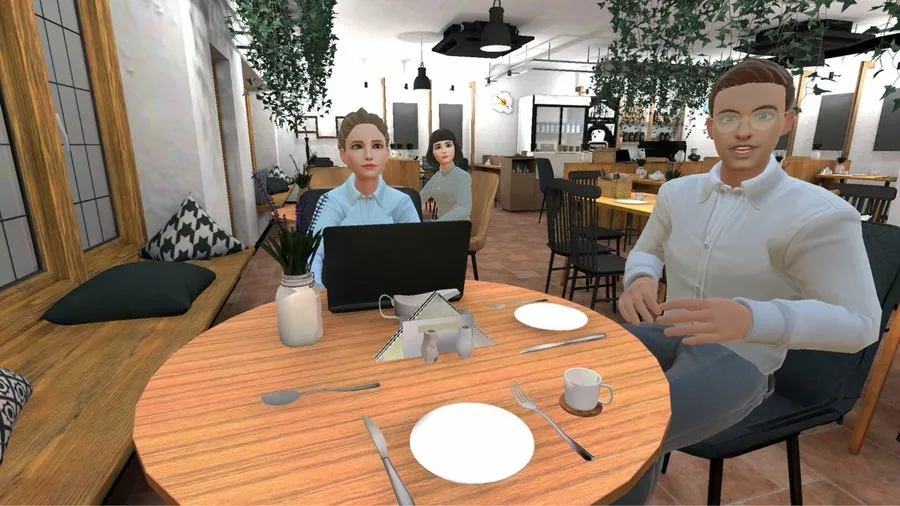
That is the narrow, honest space a tool can occupy, and it is the reason I build one. Therapy withVR gives a clinician a controllable environment to run the exposure they have already planned. You rebuild a feared social situation, a cafe, a meeting room, a classroom, an auditorium, and you shape it live from a laptop: make the room busier or quieter, let an avatar ask a hard question or stay friendly, add a little time pressure, then take it all back down. The person climbs the hierarchy at a SUDS level you both choose, repeats the step as many times as they need, and does it in a space that is private and safe to get wrong in, before they meet the situation for real.
The idea is older than the tool. The clinician controls the environment so the person can practice the situation, not just discuss it. If that fits how you already think about exposure, the page for psychologists and CBT clinicians goes into how it works in a session, and the full study record, including the limits, lives in the Evidence Hub. If it does not fit a particular client, that is a clinical call, and it is yours to make.
Common questions
What is exposure therapy for social anxiety? Exposure therapy is a cognitive behavioral approach in which a person, guided by a clinician, gradually and repeatedly faces the social situations they fear, in a planned order, so that avoidance loosens and the situation becomes more manageable. It is a core component of cognitive behavioral therapy, the first-line psychological treatment for social anxiety.
How does graded exposure work? The clinician and client build an exposure hierarchy, a ranked list of feared situations from least to most distressing, often rated with SUDS (Subjective Units of Distress). They work up it step by step, staying in each situation long enough for the anxiety to shift and the feared outcome to be tested, and repeating it until it loses its charge.
Why is exposure therapy hard to deliver in practice? Because real social situations are hard to arrange, control, and repeat. You cannot summon an audience or a difficult conversation on demand inside an office, exposure assigned as homework is often avoided, and over telehealth real-world exposure is even harder to set up. Surveys show many clinicians feel under-resourced for it.
Does VR exposure therapy work for social anxiety? Across meta-analyses, VR exposure therapy (VRET) is about as effective as in-vivo exposure for social anxiety at short-term follow-up, with large gains compared to no treatment. The evidence is encouraging but still maturing, and the clinician, not the headset, delivers the therapy. The Evidence Hub rates these studies openly, including their limits.
Is VR a treatment or a medical device? Some VR products for anxiety are regulated as medical devices, but Therapy withVR is not one of them. It is a clinician-controlled practice environment that makes no claim to diagnose, treat, or cure. Whether a product is a medical device depends on its intended use and the claims it makes, not on the fact that it uses VR. It gives a clinician a controllable place to run graded exposure practice, and the therapy is what the clinician does with it.
The treatment was never the bottleneck
You did not need this post to tell you exposure works. The harder truth is the one underneath it: one of the best-evidenced things you can do for social anxiety is also one of the most awkward to actually deliver, which is why so much of it quietly gets set aside. The most leveraged thing you can change is rarely the model. It is whether you can get a graded, repeatable, real-enough situation in front of the person, on the day, at the level they can take. Build that, with VR or without it, and the rest of the work finally has somewhere to happen.
References
- Sars D, van Minnen A. On the use of exposure therapy in the treatment of anxiety disorders: a survey among cognitive behavioural therapists in the Netherlands. BMC Psychology. 2015;3:26. Full text
- Boeldt D, McMahon E, McFaul M, Greenleaf W. Using virtual reality exposure therapy to enhance treatment of anxiety disorders: identifying areas of clinical adoption and potential obstacles. Frontiers in Psychiatry. 2019;10:773. Full text
- Wray, Kemp, and Adams Larsen. On low clinician adoption of virtual reality exposure therapy. Cognitive Behaviour Therapy. 2023;52(6):603-624. Full text
- Morina N, Kampmann IL, Emmelkamp PMG, Barbui C, Hoppen TH. A meta-analysis of virtual reality exposure therapy for social anxiety disorder. Psychological Medicine. 2021. Full text
- Lindner P, Dagöö J, Hamilton W, et al. A single-session virtual reality exposure trial for public speaking anxiety in routine private-clinic care. Cognitive Behaviour Therapy. 2021;50(1):67-87. Full text
- US Food and Drug Administration. General Wellness: Policy for Low Risk Devices, on the rule that intended use and the claims made, not the technology, determine medical-device status. FDA guidance VR and digital mental-health products that are regulated as medical devices include Oxford’s gameChange (CE and UKCA marked for agoraphobia) and Big Health’s Daylight (FDA cleared for generalized anxiety disorder).
Further reading
- Speaking and social anxiety - the Evidence Hub topic gathering the social-anxiety VRET studies
- Horigome et al. (2020) - the pre-registered social-anxiety VRET meta-analysis
- Carl et al. (2019) - the broad anxiety-disorder VRET meta-analysis
- Kampmann et al. (2016) - VRET alongside other technology-assisted options
- Wechsler et al. (2019) - the dose-matched VR-versus-in-person comparison
- Carryover in speech therapy - why practice has to be designed to reach the real situation
- Is Therapy withVR a medical device? - more on the practice-tool, non-device distinction