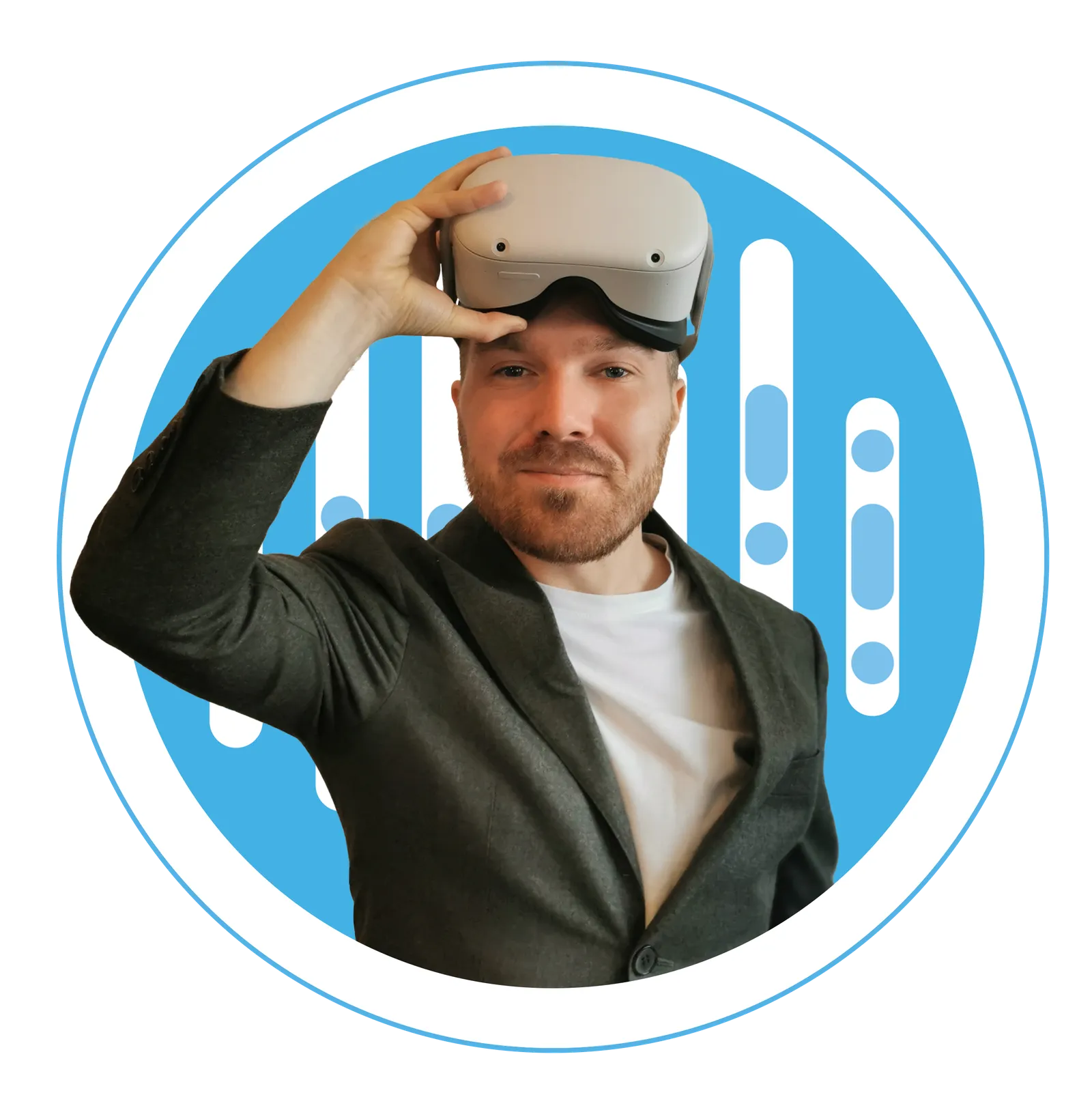
I started stuttering around the age of 6. And like many people who stutter, I spent a lot of time in speech therapy growing up.
Some of the most common approaches involve role-play. You sit across from your clinician, or maybe another person in your group, and you practice. Ordering coffee. Making a phone call. Introducing yourself at a job interview. The clinician might play the barista, the receptionist, the interviewer. You go through the scenario. And sometimes it goes well.
But here is the thing nobody says out loud: you both know it is not real. Your clinician is not actually a barista who is going to rush you. The stakes are gone. And because the stakes are gone, it does not feel the same. The anxiety that shows up in real speaking situations, the kind that tightens your chest and makes you avoid the word you actually want to say, does not always show up in a therapy room.
Role-play does not feel like real life.
So what do you do? You go into the real world and practice there. You walk into the coffee shop, join the meeting, pick up the phone. But now the problem is reversed. The real world is unpredictable. You cannot control the listener’s reaction, the background noise, the time pressure. If something goes wrong, you cannot pause and reflect. You cannot repeat the scenario with a small adjustment. You just carry whatever happened with you, sometimes for the rest of the day, or even forever.
The real world is uncontrollable.
There is a gap between these two extremes, between the safety of the clinic and the chaos of daily life. I have spent the last ten years trying to build something that sits in that gap.
Where it started
In 2016, I was finishing my BSc in Digital Media Technology and beginning to ask a question that felt deeply personal: could virtual reality make speech therapy feel more real without losing the safety of the therapy room?
That question became my first research paper, presented at IEEE, exploring virtual reality exposure therapy for people who stutter and experience social anxiety. It was early work, and VR headsets at the time were heavy, expensive, and not particularly convincing. But even then, the core idea held up. When you put someone in a virtual coffee shop and let them practice ordering, they feel something. The environment triggers a response that role-play does not. Not because VR is magic, but because our brains treat realistic environments as real enough to practice in. In fact, research is showing that VR speaking situations can elicit responses remarkably similar to real life.
I went on to complete an MSc in Medical Product Design, became a member of the British Computer Society, and continued researching how VR could serve speech-language pathology. I am currently a Research Affiliate at The George Washington University, where I continue to collaborate on this intersection of technology and communication sciences.
In 2025, I helped write the introduction to Artificial Intelligence, Automation, and Extended Reality in Speech-Language Pathology, published by Plural Publishing. That book is one small signal of a larger shift: the field is starting to take these tools seriously.
What SLPs already do is remarkable
Before I talk about technology, I want to say something clearly: speech-language professionals are extraordinary at what they do. The creativity, patience, and clinical judgment that SLPs bring to every session cannot be overstated. They build trust with individuals who have often had challenging experiences communicating. They adapt on the fly. They notice things that no algorithm ever will.
But they also work with a limited set of tools. The clinical space, no matter how warm and well-designed, is still a clinical space. It does not have the unpredictability of a crowded restaurant or the social pressure of a classroom presentation. Role-play fills part of that gap, but not all of it. SLPs have always known this. They have been asking for better ways to bridge the distance between what happens in therapy and what happens in the real world.
Technology does not replace the clinician. It works alongside them.
Here is how I think about it. SLPs do amazing work on their own. Technology, whether VR or AI, can do impressive things on its own too. But when you bring the two together, something unique happens, something that neither could achieve alone.
The clinician brings the expertise, the relationship, the clinical reasoning. The technology brings the immersive environments, the control, the repeatability. The combination means an SLP can place an individual in a realistic speaking situation (a classroom presentation, a job interview, a busy restaurant) and adjust every variable in real time. How many people are in the room. Whether they look attentive or distracted. Whether there is background noise. Whether the listener interrupts. Each of these details matters enormously, because the situations that are challenging for one person are not necessarily challenging for another.
This is the part I care about most: customization. If the VR speaking situations are not customizable, the individual is only a passenger on autopilot. They are going through someone else’s version of a hard conversation, not their own. The whole point is to recreate the specific scenarios that an individual finds challenging, then give them a space to navigate those scenarios with their clinician’s guidance. Repeatable. Adjustable. Safe, but real enough to matter.
That is what Therapy withVR is designed to do.
Built through co-creation
I want to be honest about something. This tool was not built by a technology company that surveyed the market and identified an opportunity. It was built by a person who stutters, who spent years in therapy, who knew firsthand that the gap between role-play and real life was a problem worth solving.
But that is only part of the story. Therapy withVR would not be what it is today without the hundreds of SLPs, researchers, and individuals who have shaped it. Every feature, every environment, every interaction in the software reflects feedback from the people who use it. Clinicians tell me what works in sessions and what does not. Researchers share findings that challenge my assumptions. Individuals who use the software with their clinicians describe their experiences in ways that no design document ever could.
This co-creation is not a marketing phrase. It is how the software is actually built. When an SLP in the Netherlands tells me that the avatar needs to respond differently to silences, or a researcher in the US shares data on how visual complexity affects voice production, or a teenager who stutters tells their clinician that the cafe scenario felt just like the real thing, those insights go directly into the next version of the software.
That does not make me an SLP. I am not a clinician, and I did not build this tool to replace clinical judgment. I built it to extend what clinicians can do. Therapy withVR is designed by someone with a communication difference, for speech-language professionals, shaped by every person who has contributed along the way. The clinical expertise is yours. The goal is shared.
Where things stand now
What started as a personal research question has grown into something I did not fully anticipate. Therapy withVR is now used in over 15 countries, with support from Google, Orange, and the NHS, and a growing body of peer-reviewed research.
But this post is not about milestones. I am writing this because I think the conversation about VR in speech-language pathology is still in its early chapters, and I want to be transparent about why Therapy withVR exists.
It did not start with a product roadmap. It started with a feeling that almost every person who has been through speech therapy knows: the moment you leave the clinic and realize that the real world does not work like practice. Therapy withVR exists to make that transition smaller. Not to eliminate it (you will always have to step into the real world eventually), but to give individuals and their clinicians a middle ground where meaningful practice can happen.
If you are an SLP exploring how VR might fit into your practice, I would genuinely like to hear from you. Not because I have all the answers, but because the best version of this tool will be shaped by the people who use it.
Gareth Walkom, Founder, withVR
Further reading
- 10 Ways SLPs Use VR - Concrete clinical use cases that put the ideas above into practice
- 5 Ways to Use VR Speaking Situations in Your Next Session - Five session plans with specific scenarios
- Why VR speaking situations feel like the real thing - The evidence behind why VR closes the gap
- Ecological validity in VR speech therapy - The research on whether virtual environments transfer to real ones
- Therapy withVR documentation - The full feature reference for the software described above