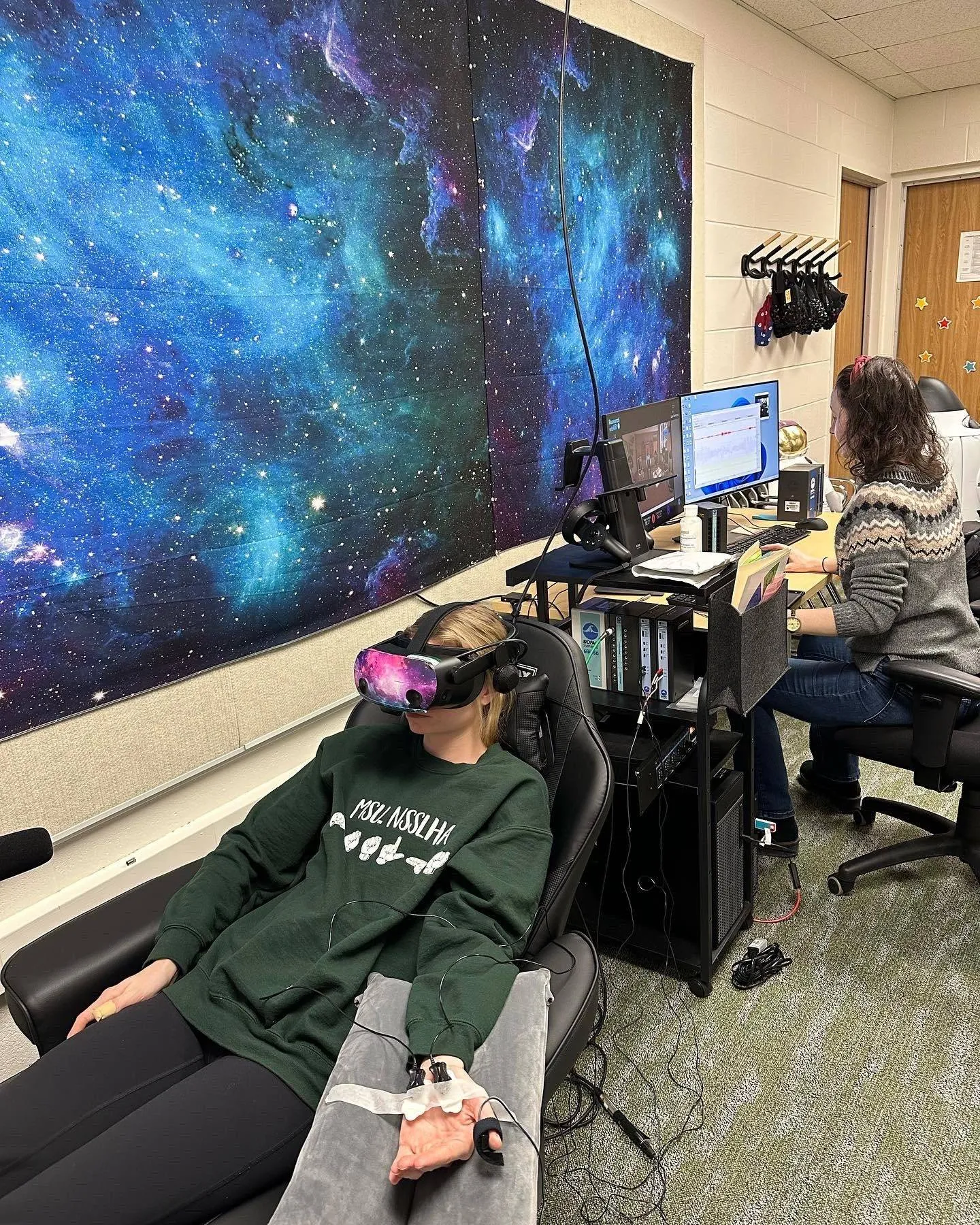
When researchers study speech and communication, they face a problem that has little to do with speech itself: consistency. A person who walks into a lab on a Tuesday morning encounters a different researcher’s tone of voice, different ambient sounds, and a different set of distractions than someone who visits the same lab on a Thursday afternoon. Those uncontrolled variables make it harder to isolate what actually matters.
Virtual reality solves this. By placing every participant in the same virtual environment with the same virtual audience, the same ambient sound, and the same visual cues, VR delivers a level of experimental control that is difficult to achieve with traditional methods.
Two decades of evidence
The idea of using VR in stuttering research is not new. Some of the most influential work comes from the George Washington University Stuttering Research Laboratory, led by Shelley Brundage.
In 2006, Brundage and colleagues published a study in the Journal of Fluency Disorders showing that speech behavior during virtual job interviews correlated strongly with that during clinical interviews. A 2015 study in the American Journal of Speech-Language Pathology went further: the primary speech measure during a challenging virtual audience speech correlated at rho = 0.99 with the same measure during a live audience speech (Brundage & Hancock, 2015). That near-perfect correlation means that, for research purposes, a well-designed virtual speaking situation can produce speech behavior that is essentially equivalent to the real thing.
These foundational studies, along with related work examining physiological reactivity and subjective distress in VR (Brundage, Brinton, & Hancock, 2016), established something critical: VR is not just a novelty in speech research. It is a valid tool for creating speaking situations that are real enough to elicit genuine responses.
Recent work using the withVR platform
In 2024, Bauerly and Jackson published “Influences of Attentional Focus on Across- and Within-Sentence Variability in Adults Who Do and Do Not Stutter” in the Journal of Speech, Language, and Hearing Research. The study used Research withVR to investigate whether directing a speaker’s attention externally (toward a moving target in a virtual environment) versus internally (toward the mechanics of their own speech) affects articulatory variability.
The findings showed that external attentional focus reduced articulatory rigidity in both adults who stutter and adults who do not stutter. For researchers, this kind of experiment would be difficult to run without VR. The virtual environment allowed the researchers to present every participant with identical visual conditions while precisely controlling attentional demands.
Why control matters for speech research
Traditional lab setups rely on a researcher reading prompts, playing audio recordings, or staging a conversation with a confederate. Each of these introduces variability. The researcher might emphasize a word differently. The confederate might pause at a slightly different moment. These small inconsistencies accumulate across dozens of participants and can obscure the very effects a study is designed to detect.
VR eliminates much of this variability while maintaining something researchers call ecological validity: the degree to which findings in a lab reflect what happens in the real world. Virtual environments are immersive enough that participants tend to respond as they would outside the lab. They feel the social pressure of a virtual audience. They react to the setting around them. The experience feels real, even though every variable is under the researcher’s control.
A growing field
In 2025 alone, withVR supported 19 research projects across universities, hospitals, and labs in multiple countries, spanning topics from stuttering and voice to social communication. The growing body of peer-reviewed work built on VR-based speech tasks reflects a broader recognition that virtual environments can serve both research and clinical goals.
For speech-language professionals following the research literature, the implications are practical. When the same platform used to generate peer-reviewed evidence is also available in the therapy room, the path from finding to practice gets shorter. VR does not replace clinical or research judgment - it gives you a controlled environment to apply it in.
All research use is covered by a formal research agreement, and no audio or video is recorded during sessions. If you are evaluating any new technology for research or clinical use, I put together a free checklist covering data privacy, AI transparency, and more.
Further reading
- Research Proposal Toolkit - Drop-in paragraphs for the parts of a grant, IRB, or pilot protocol that researchers spend disproportionate time writing
- What 20 years of VR social-anxiety research means for speech therapy - The adjacent evidence base from the social-anxiety RCT literature
- Ecological validity in VR speech therapy - A synthesis of the validation research underpinning the methods discussed above
- How to read a VR speech therapy study - For appraising new VR research as it appears
- Evidence Hub - All peer-reviewed studies on VR in speech therapy
If you are a researcher interested in using VR for speech and language research, or a clinician following the evidence base, I would love to hear from you.