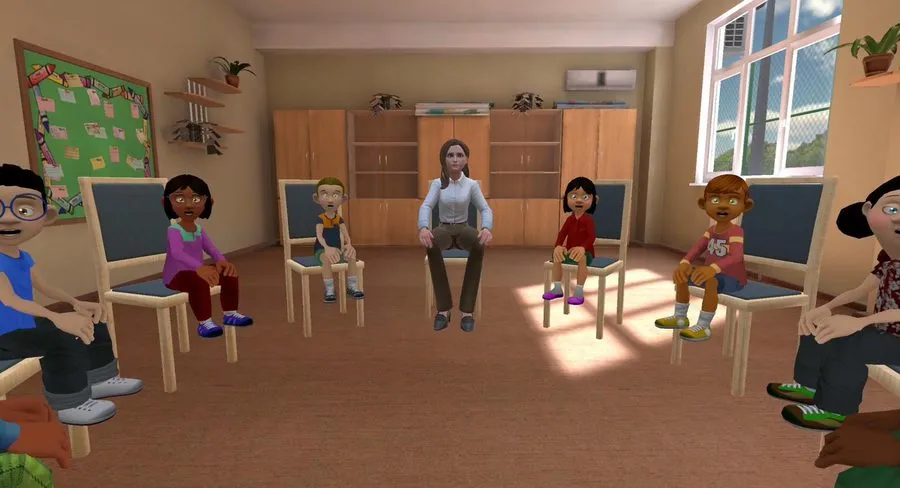
If you work in a school, the calendar runs your year. Right now, in the gap between one year ending and the next beginning, you have something you rarely get in term time: a little room to think. It is also the moment your district is thinking about money. Budgets for the coming year are being built, vendor reviews are happening, and decisions about what tools your team will have in the fall are being made now, in the quiet weeks.
So it is a fair question to ask over the summer: should I add virtual reality to my toolkit this year? I built a VR tool for speech-language work, so I am not a neutral party. But this post is not a pitch. It is the walkthrough I would want if I were a school SLP weighing this up - how to evaluate it honestly, what to ask, and how to start small enough that it helps rather than adds to your load.
First, the honest version of what VR is
VR for speech-language work is a practice tool. A clinician controls it; it does not run on its own. With Therapy withVR, one person is in the headset and you are at a laptop, shaping the scene in real time - making a cafe busier, letting an avatar ask for a repeat, dialing a classroom up or down.
It is worth being just as clear about what it is not. It is not a medical device, and it does not diagnose, treat, score, or cure anything. It does not replace your clinical judgment, and it is not a tool a student uses alone. The barriers a student runs into when they speak sit in environments and structures, not in the student - so the work is about access and participation, and the only thing worth tracking is the student’s own sense of how a situation felt. There are no accuracy percentages here. If a vendor promises VR will “fix” or “treat” a communication difference, that is your cue to be careful, not reassured.
Start with the goal areas, not the headset
The mistake is to start from the technology and look for somewhere to use it. Start from your caseload instead. VR speaking situations tend to fit the goals school SLPs already write around participation:
- Classroom participation - practicing putting a hand up, answering in front of the group, or presenting, in a setting you can pause and rewind.
- Selective mutism - graded, low-pressure speaking practice that can begin with no avatars at all and build toward a single friendly listener only as a student is ready, which mirrors the stimulus-fading logic many clinicians already use.
- Social communication and DLD - rehearsing the back-and-forth of real interactions (ordering, asking for help, joining a group) in contexts close to the real thing.
- Stuttering and avoidance - building familiarity with the situations a student has been steering around, on their own terms.
For each of these, the value is the same: graded, controllable access to the speaking situations a student actually needs to take part in. If you want to see what the research does and does not support before you commit, the Evidence Hub rates each study honestly - including where the evidence is still thin.
A summer evaluation walkthrough
Here is the sequence I would follow if I had the summer to weigh this up.
1. Pick one or two goal areas
Not five. Choose the one or two places on your caseload where a controllable speaking situation would genuinely help next year. Everything below gets easier when the scope is small.
2. See it, and check who it actually suits
Get a real look at the tool with your goal areas in mind, and think through suitability before any student tries it. A short screen - comfort, seizure history, motion sensitivity, headset fit - saves trouble later. There is a free VR suitability screening checklist you are welcome to use, whether you are evaluating Therapy withVR or any other tool.
3. Clear IT and student-data privacy early
This is the step that quietly decides whether something gets approved, so do it first, not last. Your district IT or data-protection reviewer will want to know how a tool handles student data. Good questions to ask any vendor:
- What student data do you collect, and do you need student records at all?
- How do you handle FERPA, and is a data privacy agreement (such as an SDPC National DPA) available?
- Where is data stored, and is any of it sold or used for advertising?
A tool that is built so that protected student records never need to enter it - using role-based labels instead of names, and collecting no recordings - is far easier to get through review. The US school compliance guide lays out the FERPA, COPPA, and state-law questions in plain language, and the technology checklist for SLPs is a vendor-neutral framework you can run on anything you are considering.
4. Decide how it fits the plan
VR is not a goal in itself. It is a setting and a condition inside a goal you were going to write anyway. An access-focused IEP goal like “the student will identify a speaking situation they want to take part in, set their own goal for it, and rate how confident they feel about achieving that goal before and after, across three different settings” fits VR cleanly, because you can build exactly those settings. There is a full walkthrough in writing IEP and EHCP goals around access and participation.
5. Sort the budget and a small pilot
Summer is budget season, which works in your favor. Ask whether you can start with a single seat rather than a department rollout, whether the vendor takes a purchase order or invoice, and whether a short pilot is possible before a bigger commitment. And if your funding has to be spent before a certain date, or your district would simply rather not commit to a recurring subscription, that does not have to be a barrier: licenses can be bought outright for a set number of years and seats, paid once, upfront - the same as buying long-term licenses rather than subscribing. That lets you commit this year’s budget now and keep the access running for years. A small, real trial in the fall tells you more than a big plan on paper.
What to watch for
A few honest cautions, because adding a tool badly is worse than not adding one:
- One tool at a time. The fastest way to abandon something new is to roll it out across your whole caseload in week one. Pick your goal areas and grow from there.
- Comfort comes first. A small number of people feel unsettled in VR. Screen for it, keep early sessions short and seated, and there is more on planning for this in what to plan for with cybersickness.
- It is a supervised, two-person tool. The point is that you are in the loop the whole time, able to pause, adjust, or stop. That is a feature, not a limitation.
A realistic first term
If you decide to go ahead, let the fall be small. One goal area, a handful of students, a few situations you can build well. Track confidence, notice what the students actually engage with, and let the next term grow out of what worked. The aim is not to transform your practice by October. It is to give a few students controllable access to situations they have been avoiding, and to learn how the tool fits your week.
Common questions
When is the best time to evaluate a new speech-therapy tool for school? The summer and the run-up to a new school year is the natural window. Districts plan, budget, and run vendor reviews then, so you have time to evaluate a tool, clear it with IT, and fit it to your goals before term starts.
How do I get a VR speech-therapy tool approved by my school district? Clear IT and student-data privacy early, not last. Ask what data the tool collects, how it handles FERPA, and whether a data privacy agreement is available. A tool built so that protected student records do not need to enter it is far easier to get through review. The US school compliance guide lays out the full set of questions.
What goal areas does VR fit for school SLPs? It fits the participation-focused goals school SLPs already write: classroom participation, selective mutism, social communication and DLD, and stuttering. The value is graded, controllable access to the speaking situations a student needs to take part in.
Does VR replace traditional school-based speech therapy? No. It is a tool a clinician uses inside their own work, not a replacement for clinical judgment or for the therapy you already do. Add one tool at a time, supervised, with a small first-term plan.
Can a school district buy Therapy withVR with a purchase order? Yes. You can start with a single seat rather than a department rollout, the vendor takes a purchase order or invoice, and a short pilot is possible before a bigger commitment. If your funding must be spent by a deadline or your district prefers not to use subscriptions, licenses can also be bought outright for a set number of years and seats, paid upfront - the same as buying long-term licenses rather than subscribing. A small, real trial in the fall tells you more than a big plan on paper.
That is the whole case, honestly told. I am a person who stutters, and I built this because the bridge between the therapy room and the real world is exactly where I needed help. If you are weighing it up for your school this year and want to talk it through - including with your IT or procurement team - you can always reach me directly. No pressure, and no sales script.