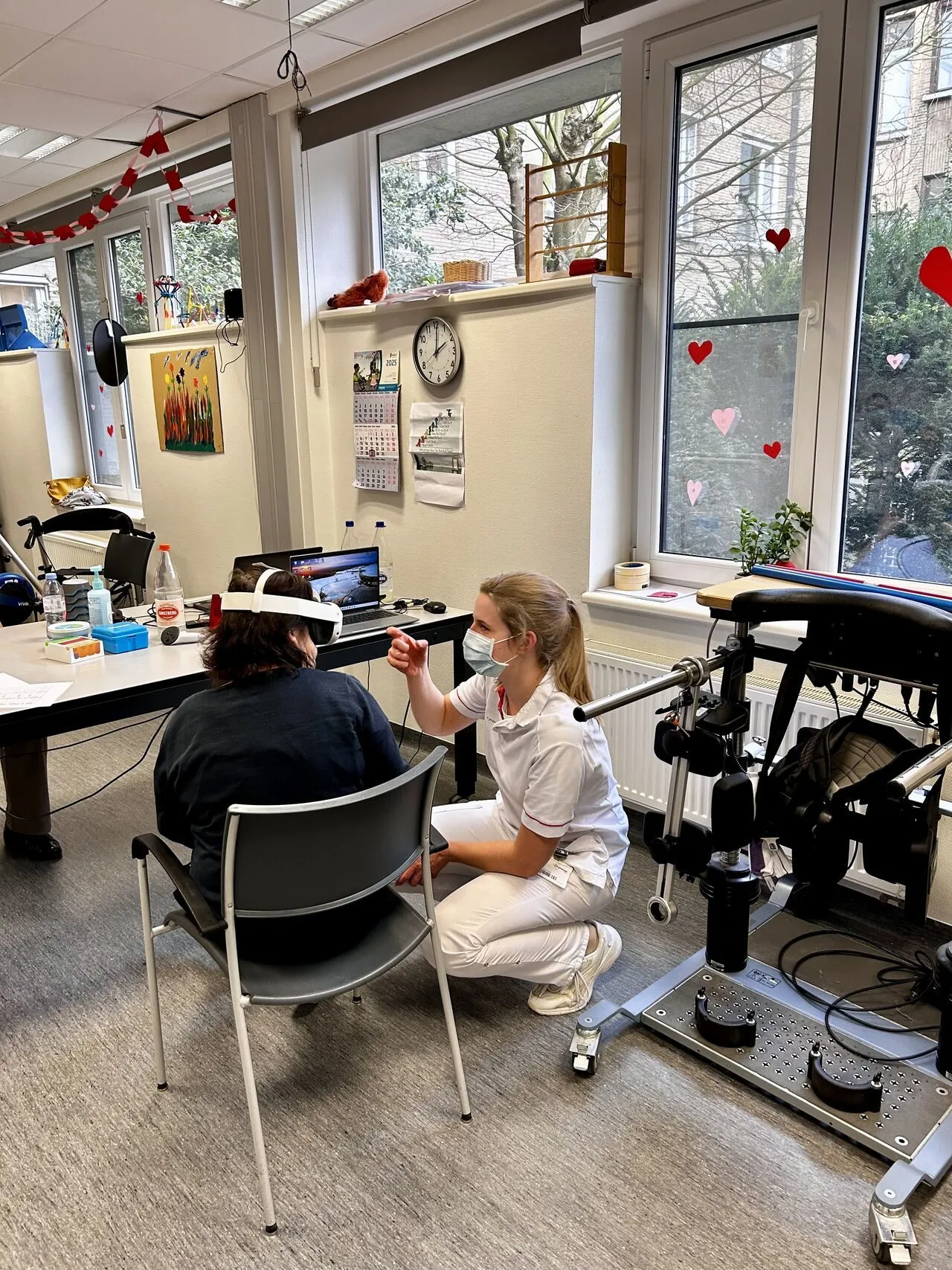
Cybersickness is the question I get asked about more than almost any other when clinicians consider VR for speech therapy. Will my client feel sick? What should I do if they do? How long can a session safely run? Are some people more affected than others? Is it the same as motion sickness?
The honest answer is that cybersickness is a real consideration that needs planning, not a deal-breaker that should keep VR out of practice. But the planning matters. Below is what the research literature says, what the clinical experience suggests, and what I have learned from working with speech-language professionals in the field.
What cybersickness is, and what it is not
Cybersickness is a set of symptoms - typically nausea, disorientation, dizziness, sometimes a headache or eye strain - that some people experience during or after using VR. The leading explanation is a sensory mismatch: the eyes see motion, but the inner ear (the vestibular system) does not feel matching motion. The brain receives conflicting signals and responds with discomfort. The same mechanism produces motion sickness in cars, on boats, or on airplanes.
Cybersickness is not the same as anxiety, even though some symptoms can overlap. It is not caused by being startled or by the content being emotionally challenging. It is caused by the visual-vestibular conflict the headset creates. Confusing the two leads to bad clinical decisions: treating cybersickness as anxiety, or treating anxiety as cybersickness, when each calls for a different response.
It is also not simulator sickness, although the literature sometimes uses the terms interchangeably. Simulator sickness historically refers to the same symptoms produced by flight or driving simulators. Modern usage tends to call all of it cybersickness when the medium is consumer VR.
How common is it in clinical VR
Prevalence rates in the research literature vary widely, depending on the headset used, the content shown, the session length, and how researchers asked. Older studies on tethered headsets with lower display resolutions reported that a noticeable minority of users experienced symptoms - often around 20 to 40 percent reporting some discomfort, with smaller percentages reporting symptoms severe enough to want to stop.
Modern stand-alone headsets - Meta Quest 2 and 3, Pico, similar - have reduced this substantially. Higher refresh rates, better tracking, lighter weight, and improved optics all matter. The most recent reviews suggest that cybersickness is less common with current consumer hardware than the older literature implies, although it has not been eliminated.
For clinical VR sessions specifically, where the content is typically static or slow-paced (a person standing in a virtual cafe, for example, rather than flying through a virtual world), reported rates are lower than for fast-motion content. Speech-therapy contexts in particular sit at the lower end of the cybersickness risk spectrum because most situations involve standing still or sitting and talking.
That said, individual variability matters more than population averages. Some people are highly susceptible. Others are not affected at all even by content that bothers most people. Plan for variation.
Who is most affected
Several factors are associated with higher cybersickness susceptibility, although none is a perfect predictor:
- History of motion sickness in cars, boats, or airplanes. People who get motion-sick in real life are more likely to experience cybersickness in VR.
- Vestibular sensitivity - people with inner-ear conditions or recent vestibular events may be more susceptible.
- Migraine history has been linked to higher rates of cybersickness in some studies.
- Female participants have been reported to experience symptoms more often than male participants in many studies, although the effect size is modest and the methodological reasons are debated.
- First-time VR users report symptoms more often than experienced users. There is a genuine adaptation effect: people who have used VR a few times often report fewer symptoms over time.
- Older adults have been reported in some research to experience more discomfort, though the picture is not consistent across studies.
For clinical practice, the implication is straightforward. Asking a client about their history of motion sickness, recent vestibular concerns, and migraine before a first VR session is a reasonable screening step. It does not predict perfectly, but it identifies the people for whom you should plan a more cautious first session.
What helps reduce it
The research literature converges on several things that help:
- Shorter sessions on first exposure, with the option to extend as the person adapts. A 5- to 10-minute first VR experience produces fewer symptoms than a 30-minute first session. Once the person has tolerated shorter exposures, longer sessions become more feasible.
- Static or slow-paced content rather than fast camera movement. A virtual environment where the user stands still and looks around is much lower-risk than one with flying, falling, or moving viewpoints. Most speech-therapy environments fall on the favorable side of this spectrum.
- Stable framerate and tracking. Dropped frames, lag, and tracking errors increase symptoms. Modern stand-alone headsets are generally good here, but underpowered hardware or buggy software can cause problems.
- Frequent breaks between sessions. Letting the person take the headset off briefly, look at the real world, and reset can reduce symptom buildup.
- Adaptation over time. Many users who report symptoms on Session 1 report fewer or no symptoms by Session 3 or 4. This is a well-documented effect.
- Hydration and food. Empty stomach or dehydration tends to make cybersickness worse. A light snack and water before the session is a small thing that often helps.
- Comfortable headset fit. A poorly-fitted headset, with the lenses misaligned or the strap too tight, increases discomfort. Spending the first few minutes of any session getting the fit right is worth it.
What to do if it happens
The most important rule: stop, take the headset off, and let the person recover before continuing. Pushing through cybersickness is a bad idea. It tends to make symptoms worse and can produce a lasting aversion to VR.
A typical recovery looks like:
- Remove the headset.
- Sit or lie down briefly.
- Look at a fixed point in the real world (out a window, at a wall) for a couple of minutes.
- Drink some water.
- Wait until symptoms fully pass before considering whether to continue.
Most cybersickness is short-lived and resolves within minutes once the headset is off. Lingering symptoms beyond an hour are uncommon but possible. If a person reports persistent symptoms or has a strong reaction, the sensible default is to skip VR for that session, debrief, and consider whether VR is the right medium for that particular person.
Some people will simply not tolerate VR. That is fine. There are other ways to do clinical work, and a tool that produces sustained discomfort for a particular person is the wrong tool for that person. Therapy withVR includes a screen-based mode for exactly this reason: a person who cannot use a headset can still engage with the same situations on a laptop or tablet.
What modern hardware has changed
If the cybersickness research you have read is from before about 2018, it is describing a different technology generation. Tethered headsets, lower display resolutions, slower refresh rates, and heavier weight all contributed to higher symptom rates in the older literature. Modern stand-alone headsets, particularly the Meta Quest 3 and similar current-generation devices, are substantially better on all of these measures.
This does not mean cybersickness has been solved. It means that the rates you might worry about based on older studies are probably higher than what you will actually see in current practice with current hardware. As always, individual variation dominates, and the screening and planning steps above still apply.
Cybersickness and Therapy withVR
Most of the factors associated with cybersickness in older research do not apply to Therapy withVR sessions. The environments in Therapy withVR do not move - the person inside VR is stationary, either sitting or standing in the same place, looking around an environment that is rendered around them but not flying or moving past them. That removes the largest single trigger for visual-vestibular mismatch.
A few other design choices reduce risk further:
- Hardware: Therapy withVR runs on Meta Quest headsets, which sit at the high end of consumer VR for refresh rate, tracking, and weight. Older studies that reported higher cybersickness rates were typically run on tethered headsets a generation behind.
- Environment quality: The virtual environments are built to a high visual standard. Stable framerate, consistent lighting, and a non-uniform field of view all reduce the cues that trigger cybersickness.
- Stop or pause at any time: The clinician can pause or end a situation immediately, from the laptop, without the person needing to remove the headset.
- Make it easier in real time: If a person reports any discomfort, the clinician can simplify the scene, reduce ambient sounds, or switch to a different situation entirely - all without ending the session.
- Clinician in full control: Every variable in the session - audience size, avatar emotional expressions, sentence text, sound design - sits with the clinician. Nothing in the experience is on autopilot.
For most people using Therapy withVR, cybersickness is not a regular concern. For the small number who are particularly susceptible, the controllability of the platform makes it straightforward to stop, adjust, and continue at a level the person can manage. The screen-based mode (without VR) is also available for anyone who does not tolerate the headset at all.
Practical takeaways
- Screen for motion-sickness history, vestibular concerns, and migraine on the first visit. Plan a shorter first session for people with positive answers.
- Start any first VR session at 5 to 10 minutes, with the explicit option to stop earlier.
- Do a fit check at the start of every session.
- Use static or slow-paced content. Most speech-therapy contexts already are.
- Take breaks during longer sessions.
- Stop immediately if symptoms appear. Recover before continuing or end the session.
- Expect that some people will adapt over a few sessions. A symptom on Session 1 does not mean VR is impossible for that person.
- Have a non-VR fallback for anyone who does not tolerate the headset. Therapy withVR’s screen-based mode is one example of this.
Cybersickness is not the reason to avoid VR in clinical practice. It is a planning consideration with a well-developed evidence base and a clear set of practical responses. Done thoughtfully, the rate at which it actually disrupts sessions is low - and when it does happen, the response is straightforward.
If you want to see how Therapy withVR handles short-session pacing, the without-VR mode, and other cybersickness-relevant design choices, get in touch.
Further reading
- VR Suitability Screening Checklist - The pre-session screening that catches motion-sickness history before the first VR session
- Session Preparation Checklist - The clinician’s pre-session workflow, including the fit check and short-session pacing referenced above
- Acceptability topic - Evidence Hub topic on how clinicians and clients experience VR
- Ecological validity of VR speech therapy - The other half of the “is this practical?” question
- Technology Checklist for SLPs - Broader framework for evaluating new technology before adopting it
- Why Therapy withVR exists - Context on the design choices that shape how VR sessions are delivered
- Further reading - Books and communities that shape current practice