People ask me, fairly often, whether Therapy withVR is a medical device - or whether it is FDA-cleared, or CE-marked. The honest answer to all three is no. I want to explain why, because the answer is not a gap, and it is not something I am quietly working toward. It is a deliberate, accurate description of what this is.
What makes something a medical device?
It is tempting to assume “medical device” is a quality badge - that a cleared or CE-marked product is the serious, trustworthy one, and everything else is lesser. That is not what the term means.
Whether something is a medical device turns on its intended purpose - the claims it makes about itself. In US law, the definition hinges on whether a product is intended to diagnose, cure, treat, or prevent disease, or to affect the structure or function of the body (21 U.S.C. 321(h)). The EU Medical Device Regulation works the same way: it is the intended medical purpose that pulls a product into the category, and with it the conformity assessment, the defined indication, and the ongoing obligations that come with making medical claims. None of that is about how good a product is, how clinical the setting is, or how customizable it is. It is about what the product says it does.
So the real question is not “is Therapy withVR sophisticated enough to be a device?” It is “does Therapy withVR claim to do the things that make something a device?” And it does not.
What Therapy withVR is
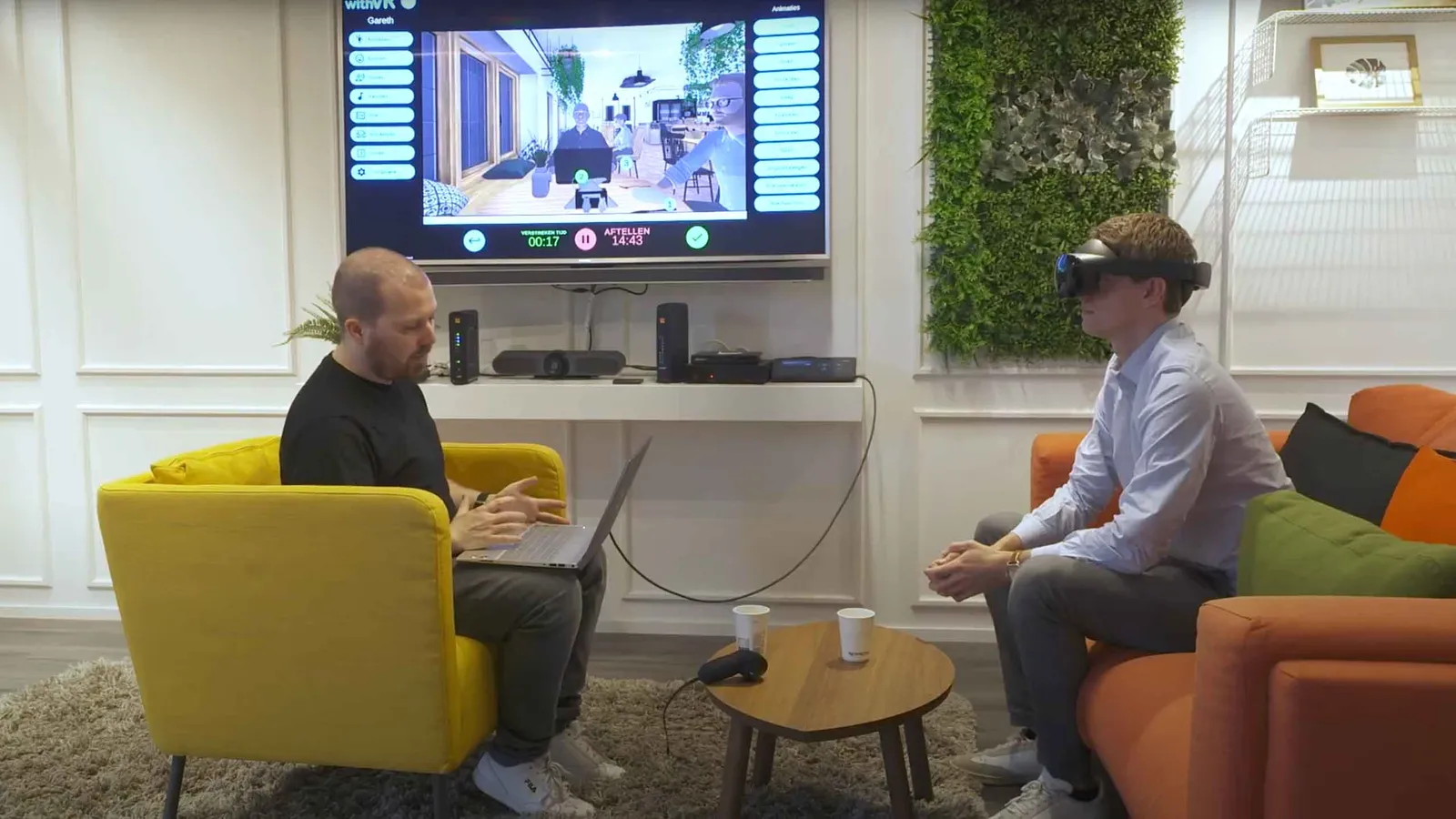
Therapy withVR is a clinician-controlled practice tool. A qualified professional runs every session from a laptop, shaping a VR speaking situation in real time while the person practices. It does not diagnose anything. It does not deliver a treatment on its own. It does not score, assess, or measure speech. It does not cure, and it does not aim to change how a person communicates.
What it does is give a clinician a controllable environment to practice real-world communication in - a cafe, a classroom, a meeting room - and the person a safe place to step into situations they would otherwise avoid. The clinical judgment, the goals, the decisions: those stay entirely with the professional. You can see how that plays out in practice on the For SLPs page. The tool is the practice space, not the practitioner.
Why “not a device” is the right fit
I get why people expect every clinical-sounding product to be a device. But for what this actually is, non-device is not a shortfall - it is the honest and better-fitting category, and it comes with real advantages.
The clinician stays in control of everything, rather than handing decisions to an automated system. Scenarios can be customized to the individual in front of you, instead of being locked to a fixed, approved indication. The software can improve quickly in response to what clinicians ask for. And it works across many populations and goals, because it is a practice environment, not a single-purpose treatment.
There is also a values point here, and it is the one I care about most. The work I am trying to support is about access and participation - helping someone take part in the situations that matter to them, on their own terms. That is the social model this whole company is built on. It is deliberately not a claim to treat or change a person, and “not a medical device” is the truthful way to say so.
”Not a medical device” does not mean “unregulated”
This is the part worth being clear about, because “not a medical device” can be misread as “outside the rules.” It is not.
Device regulation is one set of rules, aimed at products that make medical claims. Plenty of other obligations still apply to a clinician-controlled practice tool, and Therapy withVR is built for them:
- Data protection under GDPR and UK GDPR, with EU hosting and a data processing agreement available.
- Student-data privacy for schools - the platform is built so that protected student records do not need to enter it (more on the For Schools page).
- AI transparency - the AI features are off by default, and I have published an assessment against the EU AI Act.
- Accessibility and security by design, and an architecture built so that sensitive health information does not need to enter the system in the first place.
The accountability simply lives in the frameworks that actually fit what this is. You can read the full position, with sources, on the Compliance page.
Different categories, not better or worse
I want to be fair about this, because it would be easy to overcorrect. Medical-device regulation exists for good reason. When a product genuinely takes on a medical purpose - when it sets out to diagnose or treat on its own - that scrutiny is exactly right, and a buyer should expect it. If a product makes those claims, ask whether it is properly cleared or marked.
But device and non-device are different categories for different intents. They are not two grades of the same thing. For a tool that does not diagnose, treat, assess, or score, non-device is the accurate classification, not a lesser one. And the door is not closed: if Therapy withVR ever took on a genuine medical purpose, the device route would be the right path to take at that point, with everything that comes with it. What matters is that the label honestly matches the intent. Right now, it does.
Common questions
Is Therapy withVR FDA-cleared? No. FDA clearance applies to products that make a medical claim - that they diagnose or treat a condition. Therapy withVR makes no such claim; it is a clinician-controlled practice tool, so clearance does not apply.
Is it CE-marked as a medical device? No, and for the same reason. A medical CE mark certifies a product against the EU Medical Device Regulation for a stated medical purpose. Therapy withVR does not make that kind of purpose claim.
Is it HIPAA compliant? It is built to sit outside HIPAA’s scope by design - the architecture avoids protected health information rather than processing it. The full data position is on the Compliance page.
Does “not a medical device” mean it is unregulated? No. It means device law is not the framework that applies. GDPR, FERPA, the EU AI Act, accessibility, and security all still apply, and the tool is built for them.
Could Therapy withVR become a medical device later? It could, if its intended purpose ever changed to a genuinely medical one. The route is open. Today it is not a device, and that is the truthful answer.
Why I would rather be honest about this
I could probably dress this up. It would not be hard to imply more than is true and let buyers assume the rest. I do not want to build the company that way. The whole point of why Therapy withVR exists is that the people using it - clinicians, schools, the people in the headset - can trust exactly what it is and is not. If you have a procurement, regulatory, or data-protection question, the compliance page and the FAQ are the place to start, and you can always reach me directly.
So: Therapy withVR is not a medical device. It is a clinician-controlled practice tool, built honestly for the things that actually apply to it. That is not the small print. That is the product.