Journal Club Discussion Packs

Discussion prompts and critical-appraisal questions for five flagship studies covering different VR use-cases in speech, language, voice, and cognitive-communication work. Designed for SLP teams, student cohorts, and university seminars - 45-minute session format.
Cite this pack
Walkom, G. (2026). Journal Club Discussion Packs (CC BY-SA 4.0). withVR. Retrieved from https://withvr.app/resources/journal-club-packs
Get this pack
Five discussion packs (one per study) in a shared Google Drive folder. Open any one in Google Docs to copy, adapt, or download as PDF.
How to run these sessions
- Circulate the paper a week before. Each pack names the paper and DOI - everyone reads it in advance.
- 5 minutes - framing. The chair summarizes why the paper was chosen and what the session focus is.
- 15 minutes - critical appraisal. Work through the appraisal questions. Use post-its or a shared doc.
- 15 minutes - discussion prompts. Pick two or three; don't try all.
- 10 minutes - practice implications. What, if anything, changes in our work on Monday?
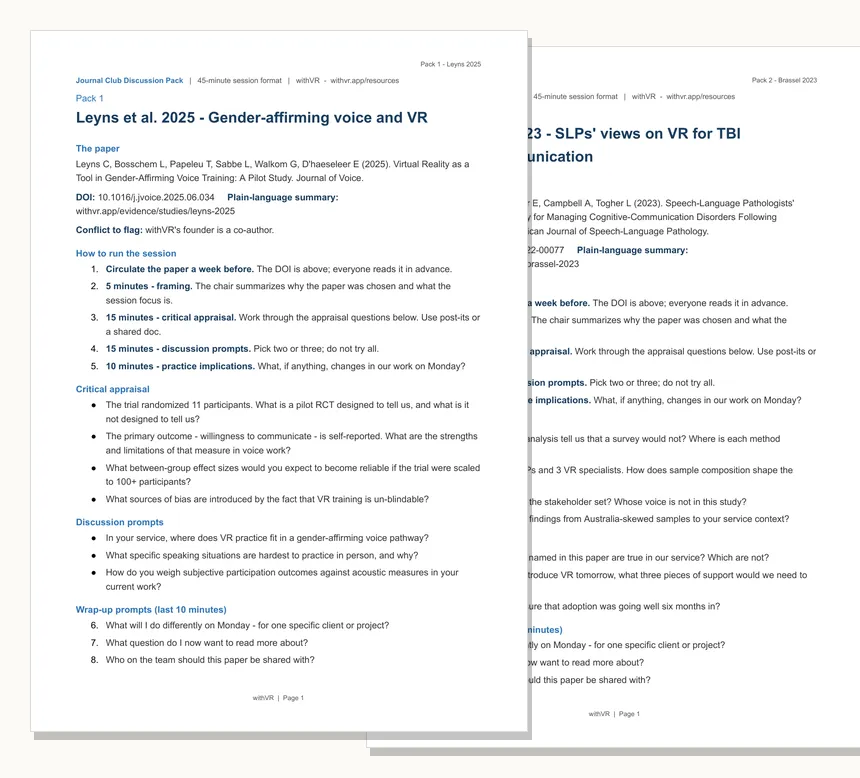
Pack 1 - Leyns et al. 2025 (Gender-affirming voice + VR, RCT pilot)
Paper: Leyns C, Bosschem L, Papeleu T, Sabbe L, Walkom G, D'haeseleer E (2025). Virtual Reality as a Tool in Gender-Affirming Voice Training: A Pilot Study. Journal of Voice.
DOI: 10.1016/j.jvoice.2025.06.034 · Summary
Conflict to flag: withVR's founder is a co-author.
Critical appraisal
- The trial randomized 11 participants. What is a pilot RCT designed to tell us, and what is it not designed to tell us?
- The primary outcome - willingness to communicate - is self-reported. What are the strengths and limitations of that measure in voice work?
- What between-group effect sizes would you expect to become reliable if the trial were scaled to 100+ participants?
- What sources of bias are introduced by the fact that VR training is un-blindable?
Discussion prompts
- In your service, where does VR practice fit in a gender-affirming voice pathway?
- What specific speaking situations are hardest to practice in person, and why?
- How do you weigh subjective participation outcomes against acoustic measures in your current work?
Pack 2 - Brassel et al. 2023 (TBI cognitive-communication, SLP views)
Paper: Brassel S, Brunner M, Power E, Campbell A, Togher L (2023). Speech-Language Pathologists' Views of Using Virtual Reality for Managing Cognitive-Communication Disorders Following Traumatic Brain Injury. American Journal of Speech-Language Pathology.
DOI: 10.1044/2022_AJSLP-22-00077 · Summary
Critical appraisal
- What does thematic analysis tell us that a survey wouldn't? Where is each method strongest?
- The sample is 14 SLPs and 3 VR specialists. How does sample composition shape the findings?
- What is missing from the stakeholder set? Whose voice is not in this study?
- How transferable are findings from Australia-skewed samples to your service context?
Discussion prompts
- Which of the barriers named in this paper are true in our service? Which are not?
- If our team were to introduce VR tomorrow, what three pieces of support would we need to make it work?
- How would you measure that adoption was going well six months in?
Pack 3 - Johansen et al. 2026 (RCT - cognitive training post-TBI)
Paper: Johansen T et al. (2026). Virtual Reality in Training of Sustained Attention, Processing Speed, and Working Memory After Traumatic Brain Injury: A Randomized Controlled Trial. Archives of PM&R.
DOI: 10.1016/j.apmr.2025.07.005 · Summary
Critical appraisal
- The pre-registered primary outcome (sustained attention) was null. How should that change how we interpret the positive secondary findings?
- Reaction times got longer and error rates dropped. Is that one finding or two? What does it mean clinically?
- Quality of life improved - but participants could not be blinded. How much of that gain is likely to be expectation?
- How would you design a follow-up trial that addresses the most important limitation in this one?
Discussion prompts
- If a paper has a null primary outcome and positive secondary outcomes, how does that change your willingness to use the intervention?
- Where does VR fit in your TBI cognitive-communication work, given this evidence?
- What real-world communication outcomes would you want a trial like this to measure?
Pack 4 - Hill et al. 2025 (Scoping review - SLT economic evaluation)
Paper: Hill J et al. (2025). Economic Evaluations of Speech and Language Therapy Interventions: A Scoping Review. International Journal of Language & Communication Disorders.
DOI: 10.1111/1460-6984.70091 · Summary
Critical appraisal
- What is a scoping review designed to answer - and what isn't it designed to answer?
- Only 18 of 43 included studies cite another included study. What does that imply about the state of the field?
- No VR-SLT economic evaluations were identified. How does that absence affect commissioning conversations?
- What "perspective" did the included studies adopt (payer, society, individual)? Why does the perspective matter?
Discussion prompts
- When your service is asked to justify a new intervention in cost terms, what data do you actually have? What would you need to make the case more robust?
- How can we do small-scale local evaluations that could later feed into a formal economic analysis?
- What are the ethical risks of framing SLT purely in economic terms?
Pack 5 - Nudelman et al. 2026 (Scoping review - immersive VR in communication differences)
Paper: Nudelman CJ, Niu J, Hutz EG, Edwards K (2026). Immersive Virtual Reality in the Treatment of Communication Disorders: A Scoping Review. American Journal of Speech-Language Pathology.
DOI: 10.1044/2026_AJSLP-25-00596 · Summary
Critical appraisal
- The review identified 11 peer-reviewed studies across nearly two decades. What does that say about the maturity of immersive VR in the field?
- Inter-rater reliability during title/abstract screening was Cohen's κ = 0.341 (fair). How might that have shaped which studies were included?
- Stuttering accounted for 45% of included studies. What does that distribution suggest about gaps and opportunities in the field?
- The review excluded non-English research. What might that exclusion miss for work in multilingual or non-Anglophone contexts?
Discussion prompts
- If you were briefing a new colleague or PhD student on "VR in our field today," would you point them to this scoping review or to a primary study first - and why?
- Which population gaps named by the review (preschool stuttering, language and cognitive-communication differences) feel most relevant to your service?
- How does a scoping review change a commissioning or grant conversation, compared with a single primary study?
Wrap-up prompts (all packs)
- What will I do differently on Monday - for one specific client or project?
- What question do I now want to read more about?
- Who on the team should this paper be shared with?
Suggest a paper. If there's a study you would like a journal club pack for, email hello@withvr.app. New packs are added as the Evidence Hub grows.
Related resources
- Evidence Hub - Plain-language summaries of all peer-reviewed studies covered in these packs.
- How studies are rated - The certainty scheme used to give each study a rating.
- Further reading - Books and communities that shape current practice.
- CAT One-Pagers - Critically-appraised topic format for individual clinical questions.
- How to read a VR speech therapy study - Practical guide to interpreting research like this.