CAT One-Pagers
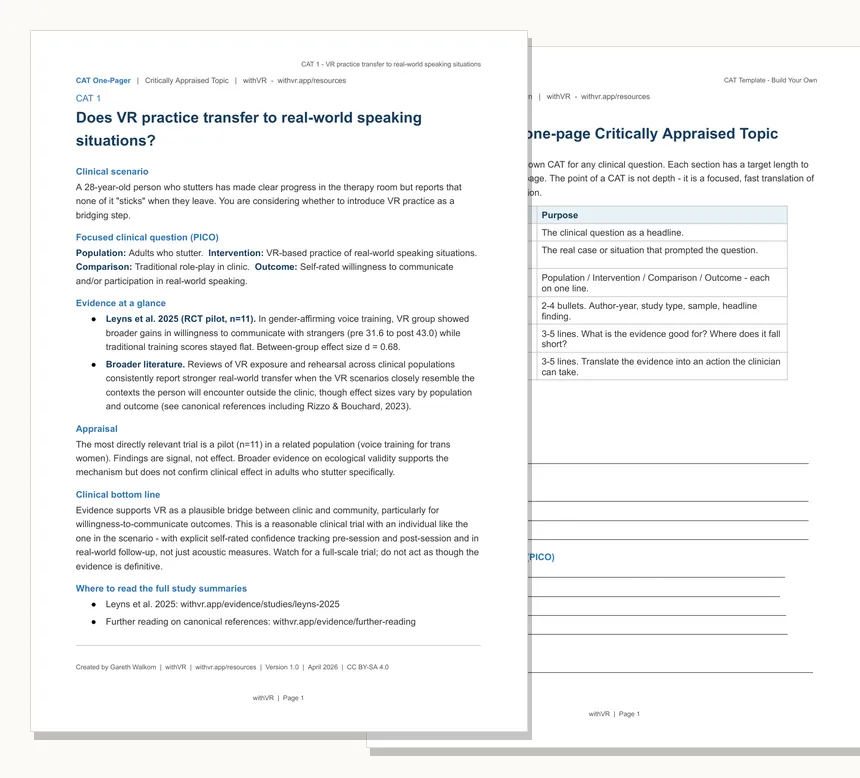
Clinically-focused one-page summaries of specific evidence questions on VR in speech, language, and communication work. Each CAT follows a structured format: clinical scenario → focused question → evidence → appraisal → clinical bottom line. Designed for team meetings, training days, and case discussions.
Cite this pack
Walkom, G. (2026). CAT One-Pagers: Critically appraised topics on VR in speech and language work (CC BY-SA 4.0). withVR. Retrieved from https://withvr.app/resources/cat-one-pagers
Get this pack
Four documents (three CATs + a build-your-own template) in a shared Google Drive folder. Open any one in Google Docs to copy, adapt, or download as PDF.
CATs (Critically Appraised Topics) are a staple of evidence-based practice training. They force a specific clinical question, a focused literature search, and an explicit "so what" clinical bottom line. These three starter CATs cover common questions that come up in VR-adjacent SLT practice. Each one can be used as-is, or used as a template to build your own.
CAT 1 - Does VR practice transfer to real-world speaking situations?
Clinical scenario
A 28-year-old person who stutters has made clear progress in the therapy room but reports that none of it "sticks" when they leave. You are considering whether to introduce VR practice as a bridging step.
Focused clinical question (PICO)
Population: Adults who stutter. Intervention: VR-based practice of real-world speaking situations. Comparison: Traditional role-play in clinic. Outcome: Self-rated willingness to communicate and/or participation in real-world speaking.
Evidence at a glance
- Leyns et al. 2025 (RCT pilot, n=11). In gender-affirming voice training, VR group showed broader gains in willingness to communicate with strangers (pre 31.6 → post 43.0) while traditional training scores stayed flat. Between-group effect size d = 0.68. (Full summary: leyns-2025.)
- Broader literature. Reviews of VR exposure and rehearsal across clinical populations consistently report stronger real-world transfer when the VR scenarios closely resemble the contexts the person will encounter outside the clinic, though effect sizes vary by population and outcome (see Further reading for canonical references including Rizzo & Bouchard, 2023).
Appraisal
The most directly relevant trial is a pilot (n=11) in a related population (voice training for trans women). Findings are signal, not effect. Broader evidence on ecological validity supports the mechanism but does not confirm clinical effect in adults who stutter specifically.
Clinical bottom line
Evidence supports VR as a plausible bridge between clinic and community, particularly for willingness-to-communicate outcomes. This is a reasonable clinical trial with an individual like the one in the scenario - with explicit self-rated confidence tracking pre-session and post-session and in real-world follow-up, not just acoustic measures. Watch for a full-scale trial; do not act as though the evidence is definitive.
CAT 2 - Is VR cognitive training useful after TBI?
Clinical scenario
A 45-year-old adult, 18 months post-moderate TBI, is working on returning to a desk-based role. They report attention and processing speed difficulties that interfere with team meetings. You are asked whether VR cognitive training would add value to their current rehabilitation program.
Focused clinical question (PICO)
Population: Adults with cognitive sequelae after TBI. Intervention: VR-based cognitive training targeting attention, processing speed, and working memory. Comparison: Standard cognitive rehabilitation. Outcome: Cognitive performance, self-reported executive function, and quality of life.
Evidence at a glance
- Johansen et al. 2026 (RCT, n=100). Primary outcome (sustained attention) null. Processing speed improved (longer reaction time + fewer errors = better attentional control). Self-reported executive function improved. Quality of life improved. (Full summary: johansen-2026.)
- Brassel et al. 2023. SLPs see VR as a plausible practice tool for community re-integration after TBI, but flag training and guideline gaps. (Full summary: brassel-2023.)
Appraisal
The Johansen trial is a well-powered RCT with a null primary outcome and positive secondary outcomes. The speed-accuracy trade-off is clinically interesting but hypothesis-generating, not definitive. VR is un-blindable, so the quality-of-life effect may be partly expectation.
Clinical bottom line
VR cognitive training after TBI should not be offered with the expectation of fixing sustained attention. It can reasonably be offered as part of a broader program aiming at processing speed, executive control, and perceived participation. Track real-world communication outcomes explicitly - the laboratory measures do not capture meeting performance by themselves.
CAT 3 - Is VR acceptable to children and the clinicians working with them?
Clinical scenario
A pediatric service is considering introducing VR-supported speech therapy for children with developmental language disorder (DLD) or cerebral palsy (CP). The clinical lead is concerned about acceptability: will the children tolerate it, will clinicians adopt it?
Focused clinical question (PICO)
Population: Children receiving speech therapy for DLD or speech-motor differences secondary to CP. Intervention: VR-supported speech intervention. Comparison: Usual care. Outcome: Acceptability ratings, retention, engagement.
Evidence at a glance
- Cappadona et al. 2023 (pilot RCT, n=32, DLD, mean age 4.8y). 100% retention across a 6-month protocol. Broader language gains in the VR group across comprehension, naming, and morphosyntax. (Full summary: cappadona-2023.)
- Mangani et al. 2024 (feasibility, n=28 + 3 home-based, CP). Good usability and acceptability for children; lower scores from clinicians, who noted hardware and software limitations. (Full summary: mangani-2024.)
Appraisal
Small pilot samples; no definitive effectiveness claim. However the consistent acceptability pattern - children rate VR higher than clinicians do - is reproducible and informative. Retention at 100% over 6 months in DLD is a meaningful feasibility signal.
Clinical bottom line
Pediatric acceptability of VR is high. Clinician acceptability is lower and tied to workflow friction rather than safety concerns. Services introducing VR in this population should plan for hardware fit, clinician workflow design, and a trial run before committing to full rollout. Child engagement should not be assumed to translate automatically into clinician adoption.
CAT template (for building your own)
| Section | Purpose |
|---|---|
| Title (1 line) | The clinical question as a headline. |
| Clinical scenario (3-4 lines) | The real case or situation that prompted the question. |
| Focused question (PICO) | Population / Intervention / Comparison / Outcome - each on one line. |
| Evidence at a glance | 2-4 bullets. Author-year, study type, sample, headline finding. |
| Appraisal | 3-5 lines. What is the evidence good for? Where does it fall short? |
| Clinical bottom line | 3-5 lines. Translate the evidence into an action the clinician can take. |
Want a CAT on a specific question? Email hello@withvr.app. New CATs are added based on what clinicians actually ask about. Candidates currently in the queue include a CAT on the McCleery et al. 2026 RCT (VR practice for autistic adolescents preparing for high-stakes social encounters), plus a field-orientation summary drawing on the Nudelman et al. 2026 scoping review of immersive VR in communication differences.
Related resources
- Evidence Hub - Plain-language summaries of every peer-reviewed study referenced in these CATs.
- How studies are rated - The certainty scheme used across the Evidence Hub.
- Journal Club Packs - Discussion-ready packs for running a paper review in your team.
- How to read a VR speech therapy study - A practical guide for clinicians evaluating any VR study.