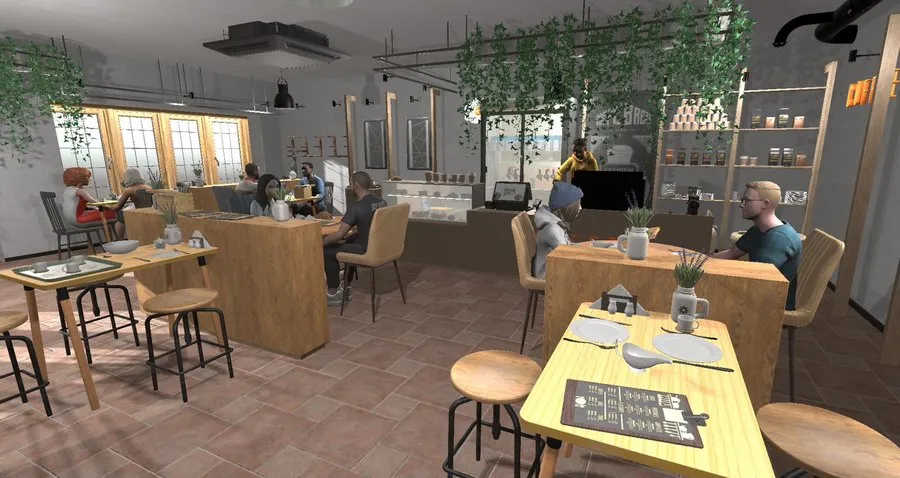
There are two very different technologies that both get called “virtual reality,” and the difference matters far more than almost anyone says out loud. One is 360-degree video: real-world footage, filmed with a special camera, that you watch through a headset and can look around inside. The other is interactive, computer-generated VR: a built, responsive world you can move through and act on, where the environment reacts to what you do.
This post is an objective summary of what the published research says about the two. It is not an opinion piece. I have pulled it from the Evidence Hub on this site and from the wider literature across education, medicine, psychology, training, and rehabilitation. Where the evidence is mixed or thin, I say so. Where 360-degree video clearly wins, I say that too.
I build interactive VR for speech and communication therapy, so I have a stake in this. That is exactly why I have tried to let the citations carry the argument rather than my preferences. The pattern that comes out of the literature is consistent, and it is not the one most people assume.
Two kinds of VR, and why people confuse them
The confusion is understandable, because both put a headset on your face and surround you with a scene. But under the hood they are opposites.
360-degree video (also called cinematic VR, cine-VR, or immersive video) is captured. A 360-degree camera films a real place - a classroom, a cafe, a crowd - and the footage is wrapped around you in the headset. You can turn your head and look anywhere, but you are watching a recording. You cannot walk over to someone, pick anything up, or change what happens. The scene runs the same way every time. In the training literature this is described, bluntly, as “read-only” (Kittel et al., 2020).
Interactive, computer-generated VR is built, not filmed. Every object, character, and sound is created in a game engine, which is what makes the world responsive. The environment can react to you in real time, the difficulty can be adjusted, characters can answer, and you can move through the space. This is the kind of VR that Therapy withVR uses, and it is what most people picture when they think of a VR “experience.”
A quick note on terms, because the field is not tidy: a lot of marketing calls 360-degree video “VR,” and some scholars dispute whether it qualifies at all, since true VR usually implies real-time interaction and motion tracking. For this post, the useful distinction is not what we call them but what they let you do.
3DoF vs 6DoF: the whole difference in one idea
If you remember one piece of jargon, make it this one, because it captures the entire split.
- 3DoF (three degrees of freedom) means you can rotate your head - look up and down, left and right, and tilt. That is all. 360-degree video is a 3DoF medium. You can look, but you cannot move your body into the scene or lean to see around something.
- 6DoF (six degrees of freedom) adds the three movements of your body through space - forward and back, side to side, up and down. Interactive VR is a 6DoF medium. You can step toward a person, crouch, walk around an object, and reach out and touch things.
That gap is not a quality problem that better cameras will fix. It is structural. A pre-recorded film is filmed from one fixed point, so it can never give you the freedom to move and act. This is why the consumer VR industry moved on from 3DoF years ago: the early 3DoF headsets built around 360-degree content, such as Google Daydream and the Oculus Go, were both discontinued, and the platform standardized on 6DoF.
The real fault line: agency, not realism
Here is the finding that runs through every field I looked at. The thing that separates the two technologies, in the research, is agency - whether you can act and be acted upon - not how realistic the picture is.
The clearest framework comes from VR scientist Mel Slater, who splits the feeling of “being there” into two parts (Slater, 2009). The first is the place illusion: the sense of being in a location. Both 360-degree video and interactive VR can produce this. The second is the plausibility illusion: the sense that what is happening is really happening to you. This one depends on the world responding to you, referring to you, behaving as you would expect. A recording cannot do that, because it does not know you are there.
Learning science says the same thing in different words. A well-known model of engagement, ICAP, ranks learning modes by how active they are, with passive watching at the bottom and interactive engagement at the top (Chi and Wylie, 2014). Watching is the weakest mode; doing and responding are the strongest.
And the exposure-therapy literature lands in exactly the same place. A scoping review of VR for social anxiety - which, notably, also looks at how to adapt it for stuttering - puts it plainly: with 360-degree video, “users are limited to passive navigation around the environment,” whereas “controlling the environment based on the user’s behavior is possible within computer-generated environments, generating greater agency.” Its conclusion is that “computer-generated environments may be more suited to targeting social interaction” (Chard and van Zalk, 2022).
That is the heart of it. 360-degree video makes you a witness. Interactive VR makes you a participant.
Does interactivity actually matter? What the evidence shows
It does, and the most useful way to see it is a counterintuitive one: across the research, “interactive” beats “immersive.” Realism and presence are not what drive the measurable outcomes. Interaction is. A few of the strongest results:
- Immersion by itself is only a small effect. A meta-analysis of immersive VR in education found an overall learning benefit of g = 0.38 - real, but modest - and highly dependent on the subject and design (Coban et al., 2022). The headset is not the lever.
- More immersion can mean less learning. In a controlled study, adding a head-mounted display to a science simulation produced more presence but less learning and higher mental load than a desktop version. The title says it all: “more presence but less learning” (Makransky et al., 2019).
- Skill gains track interactivity, not the headset. A large meta-analysis of VR in health-professions training found that higher-interactivity VR was more effective for knowledge and skills, with skill gains reaching a large effect size against traditional teaching (Kyaw et al., 2019).
- Adding interaction has a functional payoff. In a multi-center trial with older adults, adding an interactive, responsive layer to treadmill training cut falls by about 42 percent compared with the same treadmill training alone (Mirelman et al., 2016).
- Even for “real” content, interactive can beat filmed. When researchers compared ways of delivering virtual nature, interactive computer-generated VR produced significantly greater presence and better mood than 360-degree video of actual nature (Yeo et al., 2020). The built, responsive scene outperformed the real footage.
Put together, these point one way: the active ingredient in VR is the user’s ability to act and be responded to. That is precisely the ingredient 360-degree video gives up.
Where 360-degree video genuinely wins
This is not a case against 360-degree video. It has real, evidence-backed strengths, and being honest about them is what makes the rest credible. It wins when the goal is to feel or observe rather than to do.
- Photorealism of real places and faces. It is genuine real-world capture, so nobody has to model a crowd or a face. For “what does this actual place look like,” nothing beats it.
- Cost and speed. Filming a 360-degree scene is far cheaper and faster than building an interactive 3D environment. The trade-off is that, once filmed, the scene is fixed - you cannot change it without reshooting.
- Passive experiences such as pain distraction. This is the one area where passivity actually wins. A large meta-analysis of VR for pain (122 randomized trials, more than 9,000 patients) found that passive content was at least as effective as interactive content for distraction-based pain relief (Lier et al., 2023).
- Emotional impact and “being there.” 360-degree video can produce a strong in-the-moment emotional response, which is why it became popular for empathy and journalism projects. The caution from the research is that the effect tends to be short-lived and does not reliably translate into changed behavior (Martingano et al., 2022).
- Observation and awareness. For watching a scenario unfold, noticing what is happening, and discussing it afterward, a fixed viewpoint is fine and often ideal.
If your task is to put someone inside a real place and let them take it in, 360-degree video is a good tool. The question is whether your task is observation - or interaction.
A scorecard: which one wins, and for what
No technology wins everything. The honest answer is that the winner depends on the task, which is the whole point. Here is how the evidence lines up.
| What you need the VR to do | Which wins | Why |
|---|---|---|
| Let the user act, interact, and take turns | Interactive | 360-degree video is “read-only,” limited to passive navigation |
| Tailor and grade difficulty to the individual | Interactive | 360-degree video is one-size-fits-all; a built scene can be adjusted live |
| Build a skill that transfers to real life | Interactive | Skill gains track interactivity, not immersion |
| Move through and explore the space | Interactive | 6DoF vs 3DoF - the recorded viewpoint is fixed |
| Produce a sense of presence | Often interactive | Interactive VR matched or beat real footage on presence |
| Show photorealistic real places and faces | 360-degree video | It is genuine real-world capture |
| Produce something quickly and cheaply | 360-degree video | Filming beats building a 3D world |
| Distract from pain or distress (passive) | 360-degree video | Passive content is at least as effective for distraction |
| Create an in-the-moment emotional response | 360-degree video | Strong but usually short-lived |
| Drive durable change in behavior or skill | Interactive | Acting and responding outperforms watching |
The evidence base
Immersive-VR studies in speech and communication, by method
Of the immersive-headset VR studies in speech and communication, 56 used interactive, computer-generated VR and just 4 used 360-degree video.
The numbers worth remembering
- 56 to 4. In this site’s Evidence Hub, of the immersive-headset VR studies in speech and communication, 56 used interactive VR and 4 used 360-degree video.
- g = 0.38. Immersion on its own is only a small learning effect. Interactivity is the lever.
- 3 vs 6. Degrees of freedom. 360-degree video cannot leave 3DoF.
- About 42 percent. The fall reduction when an interactive layer was added to identical training.
- 122 trials, 9,000-plus patients. The size of the one clear domain where passive 360-degree content holds its own: pain distraction.
- 2018 and earlier. 360-degree video was already being labeled “read-only” in the training literature. The limitation is not new.
What this means for speech and communication therapy
Communication is interactive by definition. A conversation is a series of responses: someone speaks, you react, they react to your reaction, and the difficulty shifts in real time. Practicing it usefully means practicing that loop - at a level matched to the person, with a scene that responds. Those are exactly the things a fixed recording cannot do.
So it is not an accident that the speech and communication research has gathered, overwhelmingly, around interactive VR. The 56-to-4 split in the Evidence Hub is not a quirk of which studies I happened to include; it reflects where the mechanism of change actually lives. The handful of 360-degree video studies in the field are a mixed picture - one positive result for public-speaking anxiety (Reeves 2021), one null result for voice (Bostyn 2026), and a couple of small feasibility studies (Chard 2023, deLeyer-Tiarks 2020) - which is about what you would expect from a medium built for observation being applied to a task built on interaction.
This is why Therapy withVR is interactive rather than filmed. The case for it is not “interactive is always better.” It is narrower and, I think, sturdier: communication practice needs the scene to respond to the person and to be tunable to them, and only interactive VR can do that. If you want the longer version of that reasoning, it is on the Why Therapy withVR page.
A note for researchers
There is a practical point buried in all of this, and I want to make it carefully, as an observation rather than a verdict.
The central limitation of 360-degree video - no interaction, no individualization, a fixed viewpoint - is structural. It cannot be engineered away within the medium, and it has been documented for years. When 360-degree video is applied to tasks that depend on interaction, studies tend to re-encounter the same ceiling. That is not a criticism of any individual study; it is a property of the tool.
The constructive reading is about where research energy goes furthest. The questions that are still genuinely open are not “does a non-interactive medium support interactive practice” - the literature already points to the answer. They are questions like: where exactly does 360-degree video fit best, how do hybrid designs compare, and what makes skills learned in VR generalize to real life. Those are worth funding. Re-testing a known structural ceiling is a harder case to make.
Where VR is heading
The trajectory of the whole field reinforces the same direction. The technologies attracting the most attention now are the ones that make captured content interactive: volumetric video that lets you walk around a real, filmed person, and real-time techniques such as 3D Gaussian splatting that render photoreal captured scenes you can move through at full frame rate (Kerbl et al., 2023). On top of that, game engines are gaining characters driven by conversational AI that can respond in real time.
The common thread is that the field is converging on “photoreal and interactive.” The realism advantage that once made 360-degree video attractive is closing, while the interactivity it lacks is becoming the baseline. Betting on interaction is not just defensible today; it is where the technology is going.
The bottom line
- There are two different things called VR. 360-degree video is a recording you look around inside. Interactive VR is a responsive world you act within.
- The research divides them on agency, not realism. Across fields, interactivity is what drives the measurable benefit - “interactive” beats “immersive.”
- 360-degree video has real strengths: photorealism, low cost, passive uses like pain distraction, and strong in-the-moment emotion. Use it to observe and to feel.
- Interactive VR wins where you need to act, take turns, individualize, build transferable skill, and move through space.
- Communication is interaction, so speech and communication practice fits interactive VR. The evidence base, the mechanism, and the direction of the technology all agree.
If you want to see how an interactive, clinician-controlled VR session actually runs, get in touch.
Frequently asked questions
Is 360-degree video the same as virtual reality? Not exactly. 360-degree video is pre-recorded real-world footage you look around inside a headset. It is sometimes called cinematic VR, but it lacks the real-time interaction and movement that usually define virtual reality. Many people and products use “VR” loosely to cover both, but the two are technically different.
What is the difference between 360-degree video and interactive VR? 360-degree video is captured with a camera and is fixed: you can look around, but you cannot move into the scene, interact with objects, or change what happens. Interactive VR is built in a game engine and is responsive: the world reacts to you, the difficulty can be adjusted, and you can move through the space and act on it.
Can you interact with 360-degree video? Only in very limited ways. You can look in any direction, and some versions add clickable hotspots, but you cannot walk around, pick things up, or have characters respond to you in real time. That is why the training literature describes 360-degree video as “read-only.”
What is 3DoF vs 6DoF? Degrees of freedom describe how you can move. 3DoF (three degrees of freedom) lets you rotate your head only - the standard for 360-degree video. 6DoF (six degrees of freedom) adds movement of your body through space, so you can step, lean, and reach. Interactive VR is 6DoF.
Which is better, 360-degree video or interactive VR? It depends on the task. 360-degree video is better for cheaply showing real places, for passive experiences such as pain distraction, and for strong in-the-moment emotion. Interactive VR is better for anything that requires acting, taking turns, individualizing difficulty, or building a skill that transfers to real life.
Is 360-degree video good for speech therapy? For observation and discussion, it can help. But communication practice depends on responding to people in real time and adjusting difficulty to the individual, which 360-degree video cannot do. In the research, speech and communication VR has gathered overwhelmingly around interactive VR rather than 360-degree video.
What is cinematic VR (cine-VR)? Cinematic VR, or cine-VR, is another name for narrative 360-degree video viewed in a headset - real footage with spatial audio, structured like a film. It shares the strengths and limits of 360-degree video: high realism, but no real-time interaction.
Further reading
- Evidence Hub - The full library of speech and communication VR studies behind the counts in this post
- Ecological validity of VR speech therapy - Why a practice scene needs to behave like the real world
- Cybersickness in clinical VR: what to plan for - The other big practical question about VR in the clinic
- Why Therapy withVR exists - The design choices behind an interactive, clinician-controlled platform
- Why Therapy withVR - How the platform puts the principles in this post into practice