The VR research platform for communication science
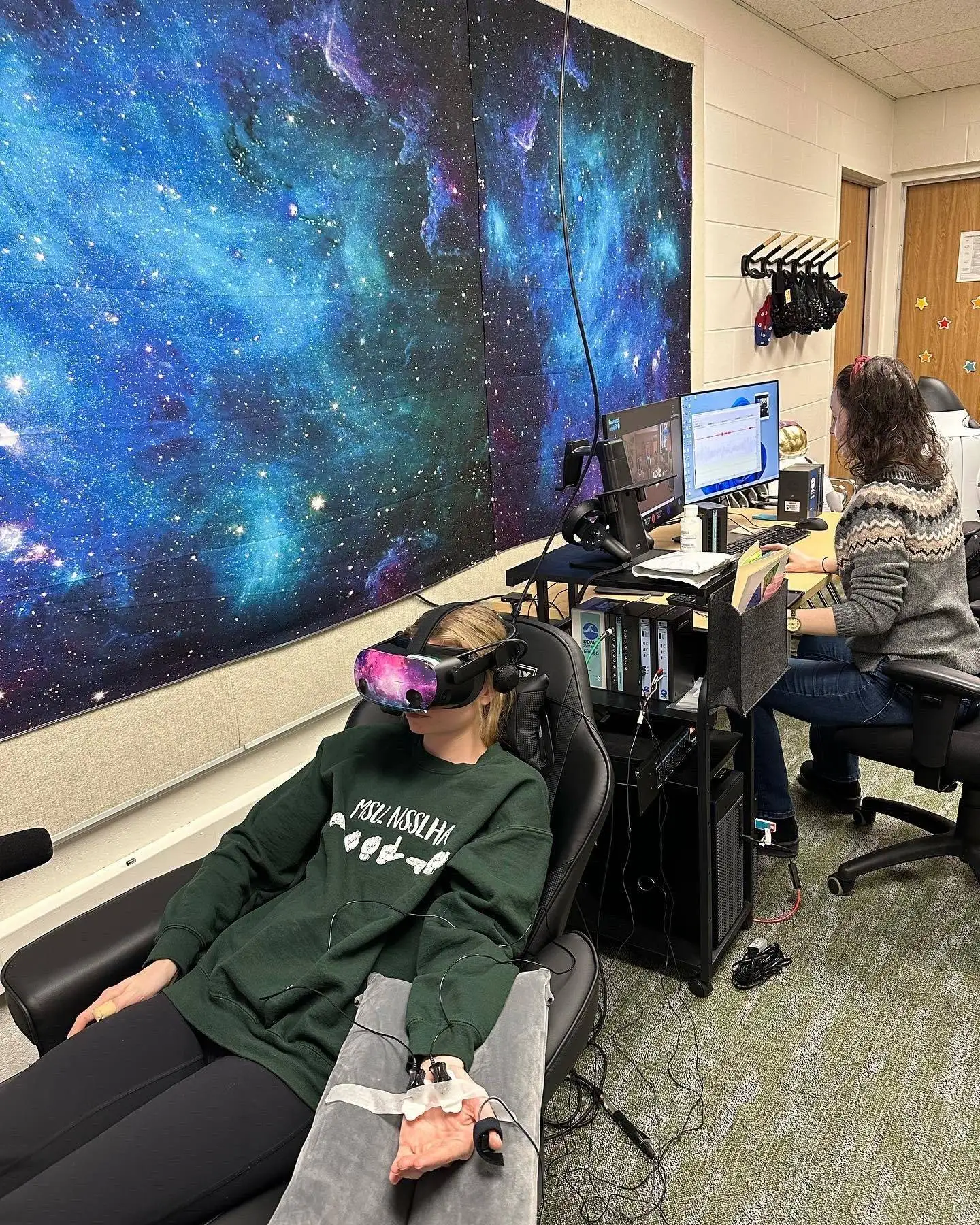
Therapy withVR is used in active peer-reviewed research at universities across many countries - George Washington University, the University of Vermont, Michigan State University, and more. This page exists to help you fit it cleanly into a grant budget, an IRB submission, or a pilot protocol. Compatible with in-lab and tele-rehabilitation research designs.
Research licensing
€49 / seat / month
Grant deadline?
Free research proposal toolkit
Drop-in IRB-ready language for grants and ethics submissions - methods paragraphs, data-handling statements, AI disclosure (EU AI Act Article 50 aligned), DPIA helpers, budget tables, and APA/MLA/IEEE citations. Copy, adapt, paste.
Open the toolkit →Why it suits research use
- Reproducible scenarios. Save complete configurations - environment, avatar placement, emotions, voices, sounds - as reusable profiles. Load the same protocol for every participant in seconds.
- Session-level event data. Each session logs which avatars were used, which emotions were triggered, which sentences were sent, and which sounds played. No audio or video is recorded by the software itself.
- Multi-protocol separation. Unlimited profiles per account - use one profile per participant, or one per condition.
- Session continuity across breaks. When you take the headset off between participants, between trials, or for a brief pause, the VR app stays signed in. No re-login when the headset goes back on; no lost state; no break in the participant's flow. Particularly relevant for repeated-measures designs and back-to-back participant runs.
- Language flexibility. 59+ avatar voices across languages - supports cross-linguistic research and multilingual participants.
- Published evidence. Peer-reviewed RCTs, experimental studies, and qualitative research already use the platform. See the Therapy withVR studies page.
- Field map. The first scoping review of immersive VR in the field (Nudelman et al. 2026, American Journal of Speech-Language Pathology) synthesizes two decades of research and is a useful starting point when orienting collaborators or grant reviewers to the field.
For your grant or budget submission
Typical research budget lines:
| Line item | Notes |
|---|---|
| Therapy withVR software subscription | €49/month per seat (ex. VAT, when billed annually), or custom research/education pricing |
| Meta Quest 3S headset (×n) | ~$350 USD / ~€350 EUR each. Purchased directly from Meta - withVR does not sell hardware. |
| Silicone face covers (hygiene, shared use) | ~€10 each; plan for one per participant pool cycle. Sold separately by third-party retailers - withVR does not sell hygiene supplies. |
| Research assistant time (setup, training) | Initial setup ~1 hour; ongoing is minimal |
Custom research and education pricing - including multi-year bundles (subscribe for up to 5 years), as many seats as you need, quotes on letterhead, and purchase-order billing - is available on request. I'm also happy to speak directly with your IT, procurement, or data-protection teams to clear any vendor-onboarding requirements. For the firewall, browser, and operating-system list to send to your IT department, see the Compatibility page. Grant deadline under 72 hours? Email hello@withvr.app with "Urgent grant quote" in the subject and the deadline, and you will get a same-business-day reply.
IRB & data handling
- GDPR-aligned. EU data hosting (Frankfurt, Germany). AES-encrypted profile names. Full privacy policy.
- No audio/video capture. The software does not record or store session audio or video. If your IRB protocol requires session recording, that can be done separately on the Meta Quest with Meta's built-in capture tools under your control.
- Session event logs only. Exported session data includes timestamps for avatars used, emotions triggered, sentences sent, sounds played. Nothing identifying the participant beyond the profile ID you create.
- Subject access rights. Participants can request data export or deletion at any time.
Need sample IRB-friendly language to cite in your protocol? Ask when you request a quote and we will send a draft paragraph you can adapt. For the full single-page overview of where Therapy withVR sits on GDPR, the EU AI Act, FERPA, HIPAA, and other frameworks, see the Compliance page.
Published studies using Therapy withVR or withVR tech
Leyns et al. 2025 (gender-affirming voice RCT) · Daşdöğen & Hitchcock 2026 (voice production) · Daşdöğen et al. 2026 (vocal intensity & distance) · Bauerly & Jackson 2024 (attentional focus on speech) · full list.
Funding bodies and research-network resources
Common starting points for communication-science researchers seeking grant funding, ethical-protocol templates, or open research infrastructure:
- ASHA Foundation - Speech Science Research Grant - $10,000 grants for new investigators in communication sciences and disorders.
- ASHA Research Grants and Funding - the central hub of grants and fellowships for SLP and audiology researchers.
- NIH NIDCD funding - the National Institute on Deafness and Other Communication Disorders, the main NIH institute for communication-science research in the US.
- NIDILRR - the National Institute on Disability, Independent Living, and Rehabilitation Research; relevant for rehabilitation-context VR research.
- Open Science Framework (OSF) - free pre-registration and open-research infrastructure used by many communication-science labs.
Next step
Include your deadline, setting, and rough participant numbers, and we will respond with a quote on letterhead.