10 Ways SLPs Are Using VR in Their Clinic Right Now
A practical, non-marketing guide for speech-language pathologists. Ten concrete clinical use cases for Therapy withVR, grounded in real sessions and peer-reviewed research.
Get this resource
Open in Google Docs to copy and adapt, or download as a PDF.
This guide is written for SLPs. Every use case below is one that clinicians are actively running with Therapy withVR today - not a hypothetical. Each one lists the caseload, the clinical goal, how the VR session is typically structured, and the evidence that supports it.
How to read this. These are starting points, not protocols. Every individual is different. Use your clinical judgment, follow your local consent and safeguarding policies, and start with the VR Suitability Screening Checklist.
1. Stuttering - graded audience-pressure practice
Caseload: Adolescents and young adults who stutter and experience anxiety in social speaking situations.
Goal: Practice high-pressure speaking moments (class presentations, job interviews, public speaking) in a safe, repeatable environment.
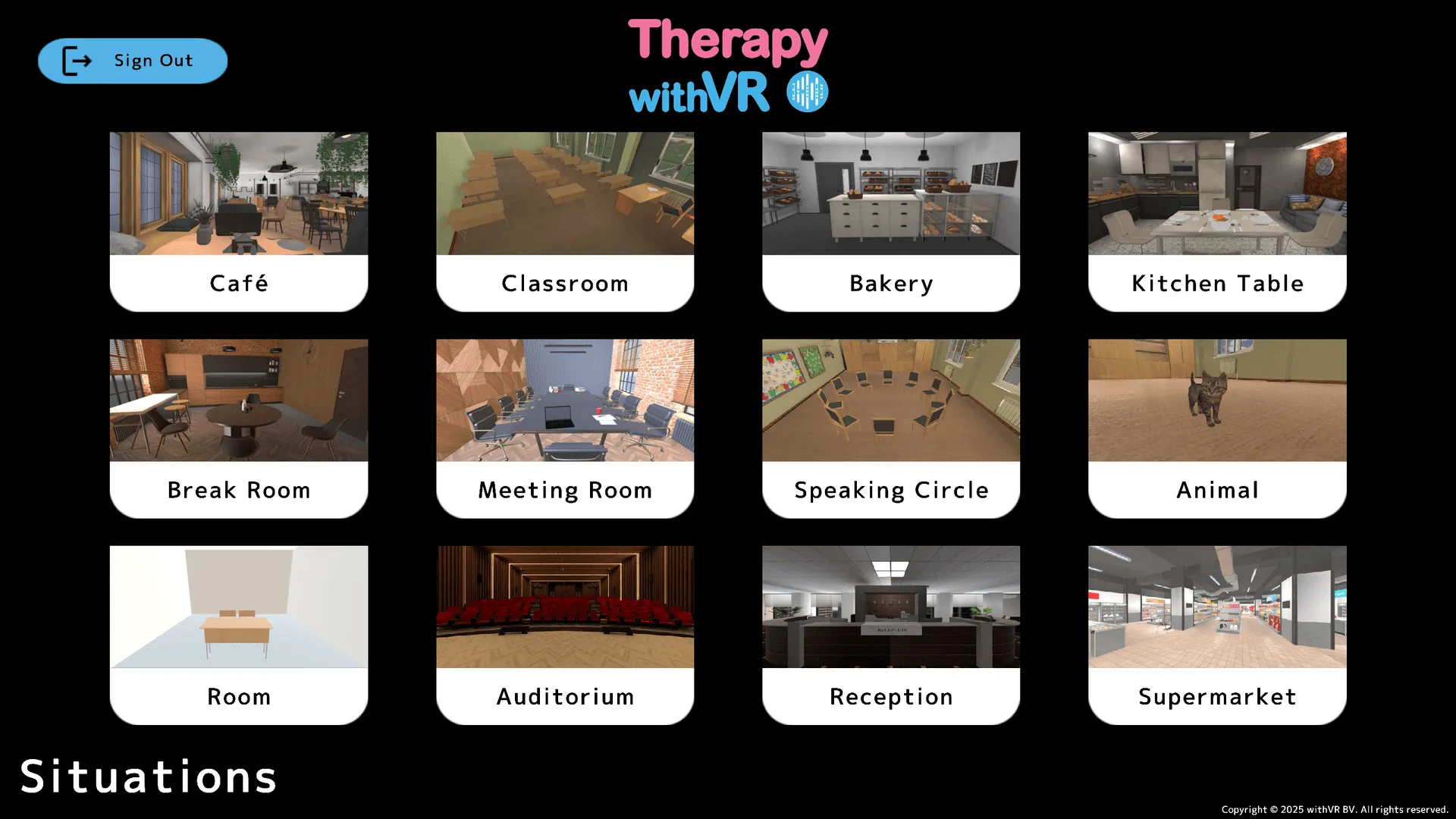
Session structure: Start in Classroom or Meeting Room with 3-4 neutral avatars. Build audience size, adjust avatar emotions across the available range (Neutral, Happy, Sad, Angry, Bored, Confused, Anxious, Excited, Calm, Surprised, Fearful), and layer in ambient sound across sessions. The clinician adjusts difficulty in real time from the laptop - pausing, simplifying, or adding complexity as needed.
Evidence: Brundage and Hancock (2015) found stuttering frequency in a challenging virtual audience correlated at rho = 0.99 with live-audience stuttering frequency, supporting ecological validity.
2. Gender-affirming voice - real-world generalization
Caseload: Transgender and gender-diverse individuals working on pitch, resonance, or intonation who find it challenging to use their target voice outside the clinic.
Goal: Increase willingness to communicate with strangers using the target voice; close the gap between clinic work and real-world use.
Session structure: Café or Reception with a single unfamiliar avatar. Practice everyday interactions (ordering coffee, asking a question). Progress to multi-avatar scenes with varied reactions - including confused or surprised - so the individual practices less-predictable outcomes in safety.
Evidence: Leyns et al. (2025, Journal of Voice) reported a randomized controlled trial showing increased willingness to communicate with strangers after VR-based gender-affirming voice training.
3. Selective mutism - non-speaking to verbal progression
Caseload: Children with selective mutism who speak at home but not in other settings.
Goal: Build verbal output through graded, low-threat scenarios before moving to real-world exposure.
Session structure: Begin in the Animal scene with no avatars so the child can acclimate to the headset without social demand. Move to a single friendly avatar in Café or Bakery only when the child is consistently verbal in the Animal scene. Keep early sessions short (3-5 minutes). Only progress to multi-avatar scenes once stable single-avatar speech emerges.
Clinical principle: Avatars reduce social threat compared with unfamiliar adults. The child chooses when to speak without real-world judgment.
4. Aphasia - functional requests and community re-entry
Caseload: Adults with aphasia after stroke needing functional communication practice for everyday life.
Goal: Practice high-frequency functional utterances (ordering food, asking for directions, small social exchanges) in realistic contexts.
Session structure: Café or Supermarket with one avatar. Prepare script cards in the Sentences tab. Use the in-VR laptop to display key words or a full script. Start scripted, progress to semi-spontaneous. The clinician controls the avatar's response - understanding first-time, asking for repetition, or clarifying - in real time.
Advantage over traditional practice: Realistic context, repeated safe attempts, and graded complexity - not possible in a real cafe.
5. TBI cognitive-communication - meeting-room dynamics
Caseload: Adults with traumatic brain injury working on attention, processing speed, working memory, or conversation management.
Goal: Practice realistic work and social meetings where cognitive-communication breakdowns most often appear.
Session structure: Meeting Room with 2-3 seated avatars. The clinician types dialogue (questions, interruptions, follow-ups) and layers in ambient sound in real time to simulate a true meeting. Start with 5-minute sessions and simple exchanges; build to 10+ minutes and multi-speaker complexity. Pause and reset whenever the individual shows signs of overload.
Evidence: Brassel et al. (2023, qualitative interviews) found SLPs receptive to VR for TBI cognitive-communication. Johansen et al. (2026, RCT n=100) tested commercial VR cognitive training in chronic TBI; primary outcome on sustained attention was null, with secondary gains in processing speed, executive function, and quality of life. Neither study directly tests VR conversation practice.
6. Voice and projection - auditorium presentations
Caseload: Teachers, presenters, and other professional voice users working on projection, clarity, and endurance.
Goal: Practice vocal projection and presence in large-room speaking; build confidence across extended presentations.
Session structure: Auditorium scene, starting empty. Populate seats progressively across sessions, layer in ambient sounds from the available categories, then change avatar emotions (e.g., from attentive Neutral to Bored or Confused) so the speaker practices managing audience attention through vocal control.
Evidence: Dasdogen and Hitchcock (2026, Journal of Voice) showed that visual distance cues in VR alone influence vocal intensity and pitch - virtual room size prompts authentic vocal behavior.
7. Dysarthria - functional high-frequency utterances
Caseload: Adults with dysarthria (stroke, Parkinson's disease, cerebral palsy, ALS) working on intelligibility in functional contexts.
Goal: Drill high-impact functional phrases (ordering, asking for help, greetings) across realistic but repeatable contexts.
Session structure: Pre-load the Sentences tab with the individual's priority utterances. Run repeated trials in Café or Supermarket. The clinician controls whether the avatar understands first time, asks for repetition, or clarifies - practicing both the utterance and the social skill of managing listener misunderstanding.
Advantage: Functional repetition of high-frequency phrases with clinician-managed listener response. Difficult to reproduce consistently in live community practice.
8. Hearing differences and hyperacusis - graded listening complexity
Caseload: Adults with cochlear implants, hearing aids, or hyperacusis working on listening in noise or sound tolerance.
Goal: Practice auditory perception and tolerance across layered, realistic environments; build comfort in settings that would otherwise feel overstimulating.
Session structure: Café, starting quiet. Layer in ambient sounds from the available categories (Ambience, Eat & Drink, Environmental). For hyperacusis specifically, draw on the Disruption, Animal & Insect, or Outdoor categories to introduce calibrated challenging sounds in predictable contexts. Adjust or remove sounds instantly if tolerance is reached.
Clinical advantage: Fine-grained control over auditory complexity that is impossible to achieve in a real cafe or restaurant.
9. Developmental language disorder - engaging language practice
Caseload: Preschool-age children (typically 4-5 years) with developmental language disorder.
Goal: Build comprehension, naming, morphosyntax, and utterance length through playful, motivating language practice.
Session structure: Child-friendly scenes (Animal, Classroom, Bakery). Set Sentence groups with target vocabulary or grammar. Keep sessions short (5-10 minutes) and informal. Avatars respond with enthusiasm and clear reactions to model target language in context.
Evidence: Cappadona et al. (2023, Children) reported a pilot randomized controlled trial of VR-supported language intervention in preschoolers with DLD, with 100% retention over six months and gains across multiple language domains.
10. Social communication anxiety - graded peer exposure
Caseload: Children and adolescents (and adults) with social communication anxiety, selective shyness, or social avoidance. Often co-treated by SLPs, school psychologists, and counselors.
Goal: Build confidence initiating conversations and introducing oneself in peer contexts through structured graded exposure.
Session structure: A five- to six-step exposure ladder. Week 1: single calm avatar, clinician-modeled self-introduction. Week 2: same scene, individual leads. Week 3: two avatars. Week 4: three avatars, neutral expressions. Week 5: larger group, mixed reactions. Practice each step to comfort before progressing. Track confidence (1-10) before and after each session.
Unique value: Genuine anxiety arousal in a safe, controllable environment with clinician support always present - something traditional in-vivo exposure and imaginal exposure cannot offer together.
Direct evidence: McCleery et al. 2026 (RCT, n=47, Journal of Autism and Developmental Disorders) tested this exact use case with autistic teens and adults preparing for high-stakes social encounters with police officers. Three short clinician-monitored VR sessions led to significantly more appropriate responses and calmer body language during a follow-up live interaction with a real officer; matched-dose video modeling did not. Summary.
What to do next
Want to try any of these with your own caseload? Start with the VR Suitability Screening Checklist, the Session Preparation Checklist, and the Informed Consent Template. Each is free, printable, and CC BY-SA licensed.
For a 20-minute walkthrough of the software with the team at withVR - not a marketing demo - book a call.
Related resources
- Explaining VR (One-Pager) - Plain-language handout for clients and families before a first session.
- VR Suitability Screening Checklist - The quick screen before a first session.
- Informed Consent Template - Pairs with the screening before sessions begin.
- VR Risk Assessment Template - The service-side risk assessment for clinical VR use.
- Session Preparation Checklist - For running each VR session well.
- IEP / EHCP Goal-Writing Template - Access-framed goals to anchor each use case.
- Goal Rating Sheet - For tracking confidence before and after each session.
- CAT One-Pagers - Critically appraised topics on the evidence behind clinical VR.
- Journal Club Packs - Discussion packs for team learning around the studies.