VR speech therapy for kids and family members - if you are here because of someone you love, welcome
Most of this website speaks to clinicians and researchers. This page is for parents, partners, siblings, and friends of someone with one or more communication differences - stuttering, selective mutism, post-stroke aphasia, a recent brain injury, voice work, or anything that changes how speaking feels. Finding the right help can be challenging. I'm glad you're here.
What Therapy withVR actually is
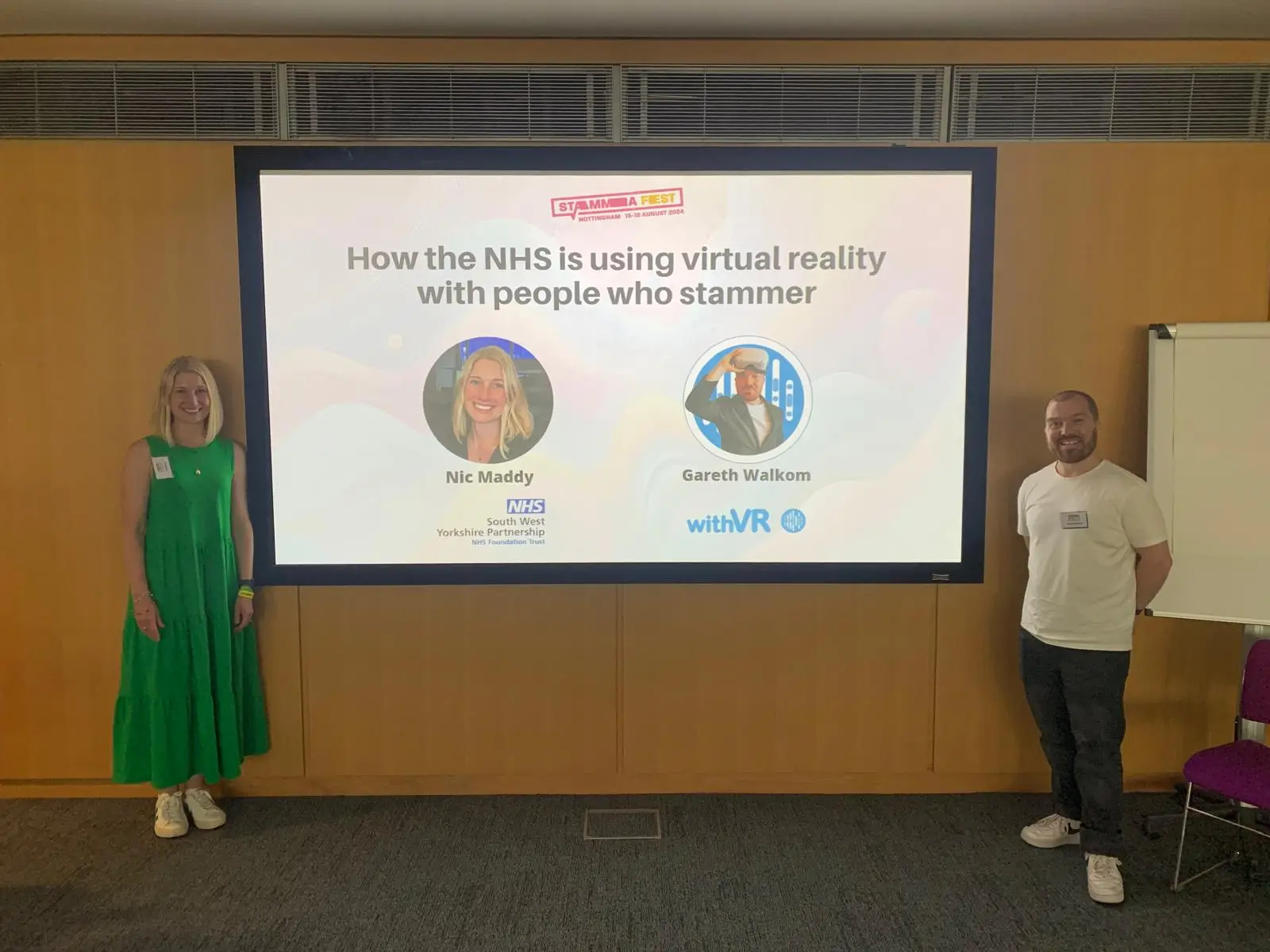
Therapy withVR is a tool for practicing real-world speaking situations using a VR headset. The person you care about puts on the headset and finds themselves in a cafe, classroom, or meeting - a situation that feels real but is safe. A speech-language professional shapes what happens, in real time, from a laptop.
It is not a cure. It is not a medical treatment. It is a practice space, designed to be used alongside a qualified speech-language professional. The people it helps most are usually those who can do something in a therapy session but find it challenging to carry into real life. Therapy withVR gives them a way to practice, with the right kind of support.
About AI features: the software has some optional AI features (translation between languages, AI-generated avatar text, and similar). They are turned off by default. The clinician will only enable them if the person you care about has agreed. They can be declined or disabled at any time.
The right first step
Therapy withVR was made to be used by qualified speech-language professionals with the people they support. It is not a tool to use solo or only at home, and I do not want to set it up that way. Working with a professional is what makes the difference.
If they already work with a speech-language professional, the best first step is to introduce me to them. Email hello@withvr.app with a few words about the person and who their therapist is. I'll talk with their therapist about whether Therapy withVR is a good fit, and how a session might look. The plain-language handout is designed for that conversation.
If they don't work with a speech-language professional yet, the community organizations below can help you find one, and offer a great deal of support in the meantime.
Community for people who stutter, and their families
If the person you care about stutters, five organizations I would point you to. All run by, and for, people who stutter, and a great place to find peer support, find a therapist, or simply not feel alone:
- FRIENDS - The National Association of Young People Who Stutter (US). Annual convention, regional events, and monthly virtual groups for children, teens, and their families.
- National Stuttering Association (NSA) - The largest non-profit dedicated to people who stutter (US). Local chapters, an annual conference, family programs, and a therapist-finder.
- SPACE - Online creative arts and community programs for young people who stutter, ages 7 to 25.
- STAMMA - The British Stammering Association (UK). Free helpline, webchat, and member community for adults, children, and families.
- Stamily - An international community for adults (18+) who stutter and their allies. Online and in-person Stamily Cafes around the world for connection, peer support, and shared stories.
For other communication experiences - aphasia, selective mutism, voice, a recent stroke - similar peer-support organizations exist for each. I am happy to point you toward the right one if you reach out.
Selective mutism community and resources
If your child experiences selective mutism, two organizations I would point you to first:
- Selective Mutism Association - the global non-profit for selective mutism. Therapist directory, family resources, evidence-based information, and an annual conference for clinicians and families.
- SMart Center (Selective Mutism Anxiety & Related Differences Treatment Center) - clinical training, family resources, and treatment information from one of the leading SM treatment centers.
There is emerging evidence for VR-based exposure as an add-on to behavioral therapy for selective mutism (Tan et al. 2022 feasibility trial; an active 2025 home-based VR clinical trial). The right starting point is still a qualified clinician familiar with SM-specific treatment protocols.
For autistic teenagers and adults - practicing stressful social encounters
If your family member is autistic and finds high-stakes social interactions (job interviews, doctor visits, encounters with police or security personnel) particularly stressful, there is now direct evidence that VR practice with a clinician alongside can carry over to real-world encounters. The McCleery et al. 2026 RCT in Journal of Autism and Developmental Disorders randomized 47 autistic teens and adults (ages 12-60) to either three short VR sessions or video modeling. The VR group gave significantly more appropriate responses and showed calmer body language during a follow-up live interaction with a real police officer; the video-modeling group did not. The right next step for your family is the same as for any communication concern: ask the clinician already involved whether immersive VR practice could fit, or use the directories above to find one.
After a stroke, brain injury, or for someone with aphasia
If your family member is recovering from a stroke, brain injury, or living with aphasia or other acquired communication change, three organizations I would point you to:
- National Aphasia Association (US) - resources for individuals and families, support groups, and information on living with aphasia.
- Aphasia Access - the Life Participation Approach to Aphasia (LPAA) clinical-community network, with a clinician directory and family-facing resources.
- Stroke Association (UK) communication support - guidance for families on aphasia, dysarthria, and apraxia after stroke; helplines and local groups.
How to find a speech-language professional who uses VR
A practical guide for the most common starting question:
- Start with your existing clinician, if you have one. Ask whether they use VR or would consider it. Bring this page with you - the plain-language handout is designed for that conversation.
- If you do not work with one yet, contact your local professional body's "find a clinician" tool. ASHA ProFind (US), RCSLT find a therapist (UK), Speech Pathology Australia find a clinician, or your country's equivalent.
- For specific populations, the community organizations above usually have a therapist directory. NSA, FRIENDS, STAMMA, Selective Mutism Association, Aphasia Access - each maintains a clinician finder for their specific population.
- Then ask me. Email hello@withvr.app with the location, the population, and the kind of work you are looking for. I keep an informal list of clinicians using Therapy withVR around the world and can point you to the closest match where one exists.
Tell me about the person you're here for
What they enjoy. What they find challenging. What a good day looks like. What they have already tried, and who they work with. I will tell you honestly whether Therapy withVR is likely to help, and what a sensible next step would be with their therapist.
- Gareth Walkom, founder. I'm a person who stutters. I started withVR partly because I got tired of speaking situations that were harder than they needed to be.