VR communication practice for aphasia, stroke, and TBI cognitive-communication
Therapy withVR supports adults with aphasia, post-stroke cognitive-communication change, TBI, dysarthria, and apraxia through controlled, tele-rehabilitation-compatible practice of real-world communication contexts. Every scenario adapts to the individual's pace, using whatever communication style is theirs.
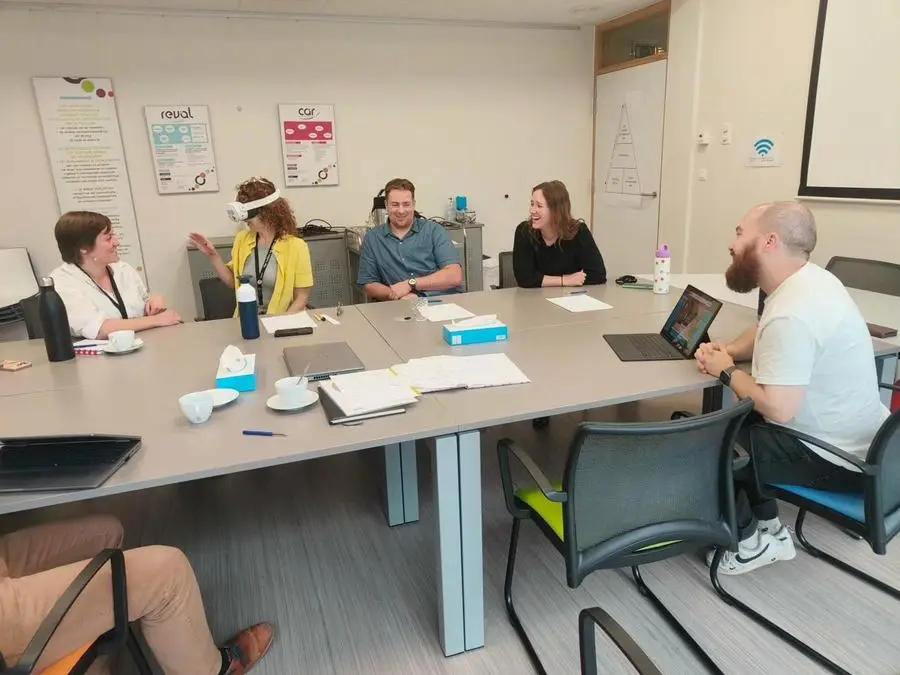
Why VR fits neuro-rehab
- Transfer gap addressed. Clinic-based practice often does not carry over to community settings. VR provides a bridge with enough ecological validity to matter, at enough safety to be tolerable.
- You set the complexity. One avatar instead of a whole cafe. Slower speaking rate. Simpler vocabulary. Pauses between turns. Adjust live as the session unfolds.
- Whatever way of communicating works, works. VR does not force an intelligibility or accuracy target. It creates situations in which people can practice participation using whichever way works for them that day.
- You stay in the room with the person. The clinician runs the session from a laptop while sitting beside the individual, observing them directly. The session can pause, slow down, or step back at any moment - making it easy to ease off before fatigue or distress builds.
Scenarios that fit aphasia and neuro-rehab work
Café / Bakery
Ordering a drink, ordering bread - high-frequency real-world tasks, scripted or spontaneous.
Reception
Phone-call-style exchanges; supports individuals recovering telephone communication.
Meeting Room
Turn-taking in a small group - useful for advocacy, return-to-work, aphasia groups.
Supermarket
Asking for help finding an item - short, situational communication with a stranger.
Customizable Room
Empty room, one avatar, your own sentences. Maximum control for early sessions - useful for things like practicing telling someone the story of a stroke at the person's own pace.
Common questions
Can I slow scenarios down for adults with aphasia?
Yes. Avatar speech rate, number of avatars in the scene, ambient sound level, and the prompts you send are all controlled from your laptop in real time. Start with one avatar, quiet ambience, and longer pauses - then scale up as the individual's tolerance grows.
Does it work with AAC users?
Honestly: not as well as we'd like, yet. AAC users currently can't see their AAC device inside VR, which limits how the platform supports them today. We are actively working on AAC integration so the device can be visible during a session. If AAC use is critical for your caseload, get in touch and we'll keep you posted on progress.
Is there evidence specific to TBI cognitive-communication?
Yes. See the Johansen et al. 2026 RCT (n=100) on VR cognitive training after TBI, the Brassel et al. 2023 qualitative study of SLP views on VR for post-TBI cognitive-communication, and related work in the Evidence Hub.
Can I share one headset across multiple individuals in a clinic?
Yes. Silicone face covers (shared hygiene) are recommended; these are purchased separately from a third-party retailer - withVR does not sell hygiene supplies. Session data stays with the clinician account, not the headset. See the Session Preparation Checklist for the full shared-use workflow.
Are AI features used with clients in neuro-rehab?
Only if you choose to enable them. Therapy withVR includes optional AI features (translation, AI-generated avatar text, transcription) that are off by default. For some neuro-rehab caseloads, AI translation can be useful when working in a second language; for others, you may prefer to keep AI features off entirely. The choice is yours, and consent for AI use should be a separate item on the consent form. See the Informed Consent Template for the AI consent language.
External resources for aphasia and neuro-rehab clinicians
Authoritative starting points beyond what is on this site:
- Aphasia Access - the clinical-network home of the Life Participation Approach to Aphasia (LPAA), with practitioner resources, research summaries, and continuing education.
- National Aphasia Association - resources for individuals and families, support groups, and clinician-friendly references including the EVA Park virtual-world project for aphasia.
- RCSLT aphasia guidance (UK) - the Royal College of Speech and Language Therapists' clinical position and resources for adults with aphasia.
- Stroke Association communication resources - guidance on aphasia, dysarthria, and apraxia after stroke; useful as a parallel for client-side reading.
- ASHA Aphasia Practice Portal - the US clinical-portal home of evidence maps, assessment summaries, and treatment guidance for aphasia.
Ready to explore Therapy withVR for your caseload?
Or start with the Evidence Hub and free clinical resources.